

Published: 22 July 2026
Something fundamental has shifted in the global luxury market. Not a cyclical correction of the kind analysts flag in quarterly reports, but a structural change in what wealthy individuals actually want and what wealth, at its highest expression, now means.
For decades, luxury was tangible. A Birkin, a Patek Philippe, or a supercar in a certain postcode: the grammar of affluence was built on objects. That model still functions, but among the wealthy, it has been demoted in favour of experiential assets. Here, the value lies not in the object acquired but in the experience lived, whether it's an ultra-exclusive wellness camp or entertaining on a private yacht.
The numbers bear this out. Euromonitor's World Market for Luxury Goods 2025 report found that experiential luxury, including high-end travel and hospitality, grew 8% last year to reach $103 billion within the broader global luxury market valued at $1.5 trillion, making it one of the fastest-growing segments in the entire sector.
Prime real estate was not immune to any of this. If anything, it became one of the clearest expressions of the shift.
The numbers
As Flur Roberts, Euromonitor International's global head of luxury goods research, put it, “wellness, lifestyle, and emotional resonance are emerging as new markers of status." Euromonitor data bears that out at scale, and zooming into the UK, that trend is just as evident.
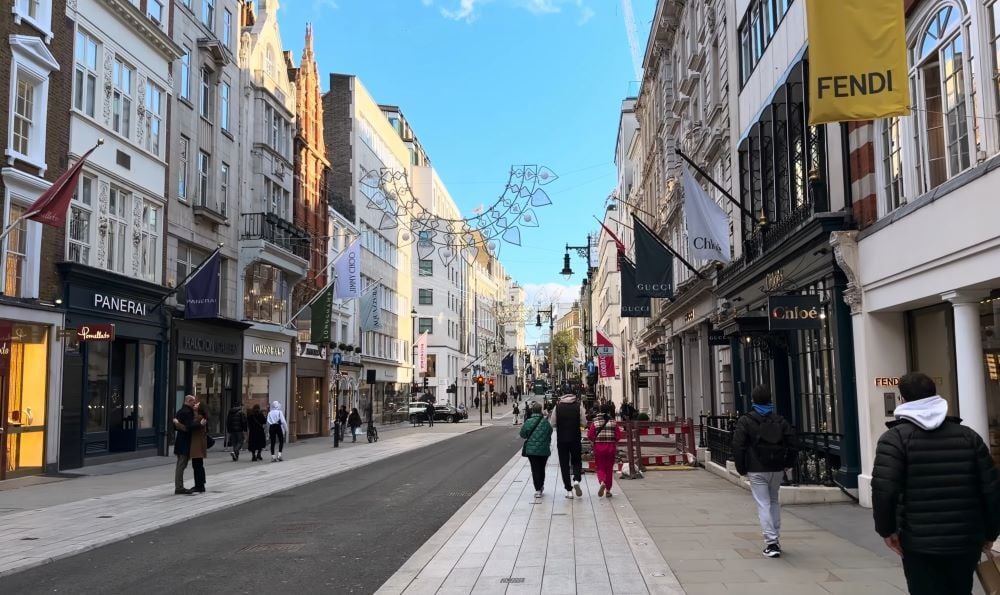
Walpole's State of London Luxury 2025 affirms London's position at the top of the European luxury totem poll, with the sector contributing £81 billion to the UK economy and sustaining 450,000 jobs. The more instructive figure, though, is behavioural. The influx of international tourists increased by 9% in 2024, and affluent visitors typically spend fourteen times more than the average tourist.
The reason, the report argues, is London's rich cachet and density of art, culture, and history. This is not incidental to luxury's appeal in the city; it is the pivot around which it turns. Walpole found that 95% of luxury brands now consider their association with art and culture important to their identity, a relationship that has grown substantive enough to generate dedicated internal departments and specialist hires. Luxury brands are increasingly producing immersive cultural experiences alongside their core offering, collaborating with artists, creators, and cultural institutions to shape the broader cultural landscape. London, then, is not simply drawing wealthy travellers. It is drawing them for what the city lets them do, access, and feel.
CBRE's analysis reinforces the retail dimension, with elevated in-store experience cited as a primary driver of luxury demand, and London's five-star hotel market continuing to strengthen on the back of rising international interest and growing pricing power. The thread is consistent across categories: in this market, experience is not a value-add. It is the value.
What turned the tide
Within ultra-high-net-worth circles, conventional luxury goods have become baseline rather than exceptional. A rare watch or a supercar retains its value, but it no longer differentiates, and when ownership loses its signalling power, experience fills the gap in ways that are far harder to commoditise or replicate.
Sociologists describe this as a move from conspicuous consumption to conspicuous experience. A once-in-a-lifetime Antarctic expedition or a bespoke wellness retreat at a five-star hotel communicates taste, curiosity, and a level of access that a purchase receipt cannot. Today, there is a growing admiration for exactly this kind of cultural fluency and influence over displays of wealth, and social media made that shift even more pronounced. Luxury brands were quick to recognise that the most powerful thing they could offer was no longer a product but a world to belong to, and the industry rebuilt itself around that idea. Experience, in this sense, has become a form of capital in its own right.
The pandemic sharpened these priorities with unusual force. Restrictions on movement and connection reminded even the wealthiest that certain freedoms could not be bought, and spending patterns shifted accordingly. Wellness, privacy, and more deliberate ways of living moved to the fore, with many high-net-worth individuals emerging from that period considerably less focused on accumulation.
Significant still, is the practical dimension of it all. For ultra-high-net-worth individuals, time is the resource in shortest supply, and convenience, privacy, and end-to-end service have become as sought-after as any physical asset. The growth of private aviation, concierge medicine, and fully serviced residences all point in the same direction.
How does this look in luxury real estate?
The same values reshaping how wealthy individuals spend on travel and wellness have worked their way into how they think about where they live. In prime and super-prime residential property, the shift is increasingly legible: buyers are drawn to branded residences, wellness-integrated schemes, and developments that offer a curated way of life.
London's market reflects this clearly. Analysis of the city's luxury residential sector points to growing demand for homes that combine private members' club access and hotel-grade amenities as standard. International high-net-worth buyers arrive with expectations shaped by the best hospitality brands in the world, and the residential offer is being built to meet them. CBRE places London's luxury branded residences at between €30,000 and €100,000 per square metre, the highest range of any European city in its study, and forecasts further growth as buyers weigh lifestyle and identity alongside the balance sheet.
According to Branded Living's 2026 London guide, around 65% of branded residence stock sells relatively quickly compared with non-branded prime equivalents, with assets typically moving within 180 to 365 days, which is notably efficient for the super-prime end of the market. Rental yields run at 2 to 3%, with annual capital appreciation of 3 to 5% in prime London locations.
United Kingdom Sotheby’s International Realty has seen this appetite translate directly into deal activity. The firm recently completed three successive sales at Knightsbridge Gate with a combined guided value of £67 million, a sequence that speaks to the depth of demand for well-positioned, lifestyle-led schemes in London's most coveted addresses.
Final thoughts
As the boundaries between hospitality, wellness, culture, and residential property continue to blur, the old mantra of "location, location, location" is being retired. The assets that will shape the next chapter of luxury real estate will be those that orient themselves around experience, service, and identity.
For London, that is less a challenge than a natural advantage. The city has always worn its culture and history with pride, and it is that cultural immersion the modern high-net-worth buyer is seeking. Whatever noise surrounds wealth migration and capital flight, London's ability to deliver on the experiential premium remains largely unmatched, and that is a considerable foundation on which to build.