

Published: 13 May 2026
The overriding theme of the 21st century has been one of limits. It is impossible to ignore the situation that we collectively find ourselves in, where the materials and resources that were once relied upon are limited and restrictive. Also, they can often present significant dangers and must be used sparingly with a clear focus on renewal, reuse and recycling.
Our Buildings Should Not Cost the Earth
For architects and designers looking to create the built environments of the future, this is an incredibly difficult challenge to navigate. The facts tell their own story on how the construction sector has been a major contributor to the precarious position that we are currently faced with:
- Buildings & the construction industry account for 37% of energy-related CO2 emissions
- The construction sector uses one third of all global resources
- It consumes 36% of global final energy
- Construction, demolition & excavation are responsible for 60% of UK waste
Legislation and greener regulations for countries across the planet only go so far to address this problem. There is now a huge responsibility placed on designers and architects to implement their imagination and innovations through the application of sustainable architecture.
What is Sustainable Architecture?
In its simplest essence, sustainable architecture is an approach to design that considers the environmental impact of a building throughout its entire lifecycle. It must consider, appreciate and understand everything from materials and construction through to maintenance, future developments and eventual reuse.
This is a strict discipline with key goals to refer to at all times:
- Reduce carbon emissions
- Reduce energy consumption
- Preserve natural resources
- Preserve biodiversity
- Minimise pollution and waste
- Improve social wellbeing
- Improve economic output
All of which delivers a new manifesto to create buildings and infrastructure that support and work in tandem with its environment, not in direct conflict with it. The places we build must no longer be viewed as objects in isolation. Rather, they should make up part of a holistic whole with their immediate landscape and the wider world beyond it.
Ancient Roots with Modern Applications
Most of human history involved sustainable architecture in a natural way. Buildings and communities were created using locally sourced materials in response to their immediate environment. This involved natural ventilation, orientation towards the sun and a flow throughout the day that worked in cycles of light and shade.
Evidence of this methodology is still found all over the world, with important lessons to learn from it. The mud bricks of hot climates, inventive use of timber structures in the forest and stone structures in the mountains were all created with the ultimate efficiency and durability that would allow them to survive for generations of communities that lived there.
Past Pioneers
Figures like the Egyptian architect Hassan Fathy were keen to demonstrate exactly how this ancient philosophy could be adapted for modernity in the 20th century. His work was considered radical at the time. Fathy was advocating for low-carbon materials and passive cooling in a pioneering way that looked back to our predecessors from a time of pre-industrialisation. His local knowledge was clearing a path for global application.
The New Gourna Project near Luxor between 1945 and 1948 was a wonderful showcase of his methods. Residents were rehoused in ancient tombs using mud brick construction and wind catchers for natural ventilation, with domes and vaults instead of timber roofs. Importantly, the project involved sharing these construction skills with the people that built their lives there, allowing for affordable housing and social sustainability to develop long after his work was completed.
Sustainability Landmarks
The sustainable architecture movement, as we know it, emerged alongside a better understanding of the damage that was being done to the environment. Pollution, energy use and building performance all began to enter the global conversation during the 1960s and 1970s, with landmark events appearing from the 1990s onwards that included:
1990 – BREEAM Launched in the UK
The Building Research Establishment Environmental Method represented the first of its kind anywhere in the world.
1998 – LEED Certification Introduced in the USA
The Leadership in Energy and Environmental Design transformed sustainability ideas for buildings into a global standard.
2010 – The Net Zero Era
The idea of a building operating on a carbon-negative basis eventually took hold. Constructions were now being designed with a goal to produce as much energy as they consume and minimise environmental risk.
The Passive Design Priority
There is a general consensus for sustainable architecture that passive design is its first principle. This involves reducing any energy demand before the first fix of utilities or technology to support the building performance, which has been implemented with:
- Maximum light orientation
- Natural ventilation strategies
- Thermal mass for temperature regulation
- Passive shading for heat gain reduction
As one can see, much of this is from lessons learned across the ages. However, there is a collection of truly modern sustainability elements that align with these fundamentals, such as:
- Low-carbon construction workflows
- Minimised waste with recycled and renewable materials
- Renewable energy systems
- Digital smart monitoring and energy management
- Adaptable design for future sustainability applications
The Beauty of Sustainability
Crucially, making a building sustainable does not mean compromising on the aesthetics. Instead, it encourages new ways of embedding this important philosophy into the design from the first sketch.
Bosco Verticale
Milan
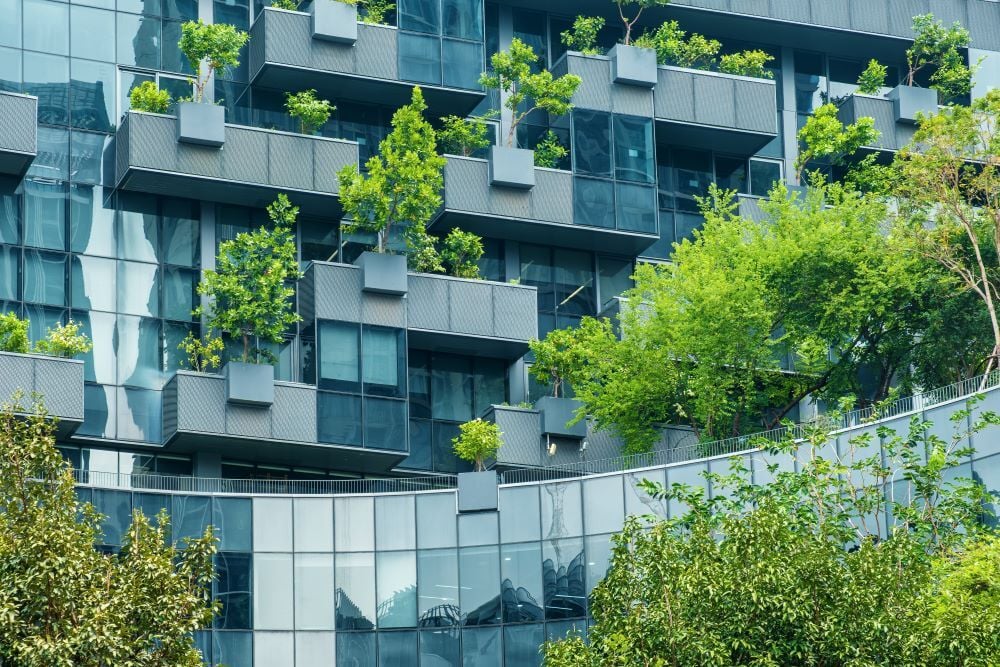
These wonderful residential skyscrapers in Milan are covered by over 90 species of growing vegetation. The air quality of the neighbourhood has increased, and biodiversity is championed in a brilliant example of a structure that remains sympathetic to the natural world that would once be lost.
Pixel Building
Melbourne
This was conceived as Australia’s first carbon-neutral office building. It generates all of its own energy through turbines and solar panels on the roof, with ambitious rainwater harvesting and greywater recycling conducted on-site. Pixel marked a transition point from concept to creation with a colourful façade that certainly does not lack any visual impact either.
The Next Wave
Sustainable architecture is accelerating with research and development every year. Innovations like neutralisation bricks that are filled with algae to generate energy and absorb greenhouse gases may soon be a reality. Similarly, solar glazing is proving to be a very fruitful area with glass that creates a building’s own energy source from its own structural materials.
Sustainable buildings are now on course to become living systems. The architecture of self-sufficiency for the built environment is what drives designers and construction developers well into the second half of the 21st century.
It will be through a conversation between technology and nature that the most effective solutions finally emerge and sustainable architecture is showing great skill at present in leading that very important debate.