

Published: 13 October 2026
Some streets change overnight. Streatham Hill has been changing for a century, slowly enough that most of its residents describe it in the present tense: an area on its way rather than one that's arrived. The Croft, a new collection of five architect-designed homes set behind a gated drive at the northern edge of Streatham Hill, near Tooting Bec Common, belongs to that same unhurried pace. It isn't trying to announce itself. It's simply the latest, most considered chapter in a piece of land that's been steadily shaping this corner of south London since long before anyone thought to call it up-and-coming.
A Plot with a Past
The land itself carries more history than a new development usually can. It was once part of the Woodfield House estate, one of the great private landholdings of nineteenth-century south London, long before the surrounding streets of Streatham Hill were laid out in the 1920s and 30s. The approach to the site today still follows a route that can be traced on maps as far back as 1913, a small but telling detail: this is a place that has always had its own private drive, long before privacy became a selling point.
The house that stood here more recently had its own story. A half-timbered, Arts and Crafts-influenced home, designed by the local architect Edward Wallis and built in 1933, extended two years later, it remained in continuous residential use for over ninety years, the last four decades as a single family home. When the time came to reimagine the site, the brief wasn't simply to build, but to act as stewards of the land, leaving something worthy of the life that had been lived there. That instinct, more custodianship than development, runs through everything that's followed.
Five Houses, One Idea
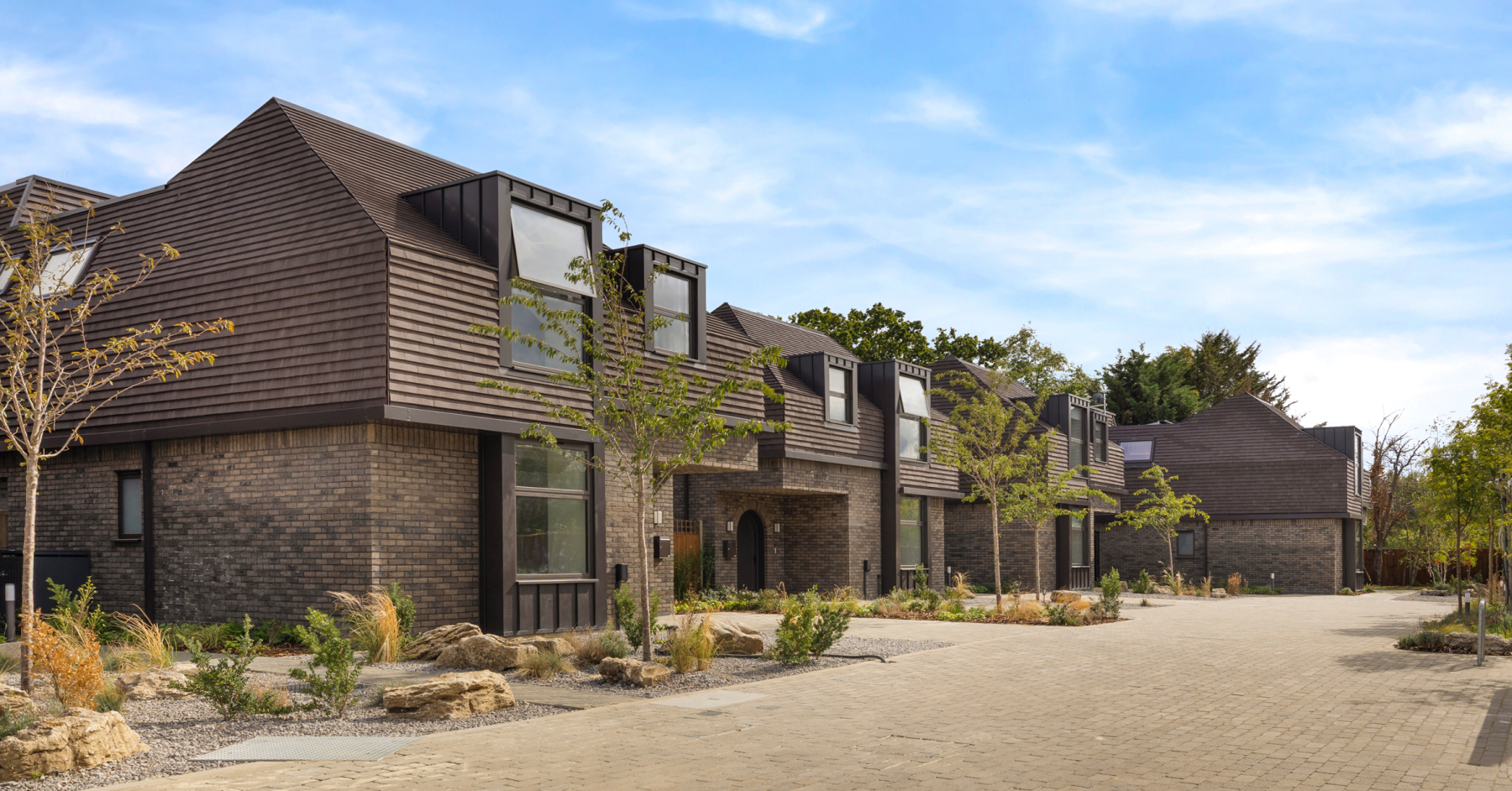
The Croft comprises five detached houses, each with its own garden, arranged within a private, one-acre enclave insulated from passing traffic. The design language draws directly from what's already there: pitched roofs, warm brickwork and the generous proportions of Arts and Crafts architecture, reinterpreted with a contemporary clarity rather than a pastiche of it. Multi-toned brickwork gives each facade depth; dark bronze window frames catch the light differently through the day; arched brick entrance recesses offer a subtle, contemporary echo of the original house's own arched doorway. Sedum-planted green roofs crown each home, softening the rooflines and extending the planting skyward.
The signature move, though, is internal. Each house is arranged over three storeys around a double-height glass atrium, open to the sky, with a single Japanese Acer planted at its centre. It's a small nod to a much older tradition of courtyard living, and it does more than let light travel deep into the plan. The tree becomes a kind of living calendar: translucent red in spring, deepening to green through summer, glowing amber by autumn, then bare enough in winter to let the light flood through uninterrupted. It's the detail visitors tend to remember, and residents, by all accounts, don't tire of.
Inside, the palette stays restrained and tactile: natural oak, porcelain stone, soft linen, joinery integrated rather than applied. Nothing shouts. The houses are built, instead, on the same logic as the brickwork outside, that good material and good proportion age far better than anything chasing a trend.
An Emerging Destination
Part of what makes The Croft's arrival feel timely is where it sits. This stretch of south London, tucked between Balham and Streatham, near Tooting Bec Common, has spent the last few years steadily becoming somewhere people move to rather than pass through. To the north, Balham has built a reputation as one of London's more village-like enclaves, its high street thick with independent cafés and restaurants, the kind of place where a Saturday morning is genuinely built around where to get coffee. To the south, Streatham's high street, one of the longest in south London, has been finding its own identity, with a new generation of restaurants and an annual food festival that now draws visitors from well beyond the neighbourhood.
The green space is a large part of the appeal too. Tooting Bec Common and its Lido, one of Europe's largest open-air swimming pools, sit within easy reach, alongside the ornamental gardens of Streatham Common. It's a rare combination for inner London: genuine, mature green space, a high street with real character on both sides, and fast rail connections into the centre, all within a single postcode that has, until recently, flown well under the radar.
That's the context The Croft has been built into: not a neighbourhood being manufactured around a new development, but one that was already becoming something, and a house, finally, considered enough to match it.