

Published: 14 October 2026
At 800 feet, the highest town in the Cotswolds sits at the meeting point of seven old roads. It has been trading sheep, and more recently antiques, on the same market square for over 900 years.
Where Seven Roads Meet
Stow-on-the-Wold has a market charter dating to 1107, granted by Henry I, and for several centuries after that it was one of the great sheep fairs of England: on a good day in the 1600s, as many as 20,000 sheep changed hands in the square. “Stow-on-the-Wold, where the wind blows cold” runs the old saying, and it’s not wrong, the town sits exposed on a limestone ridge with nothing much between it and the weather. But that same crossroads position, on the old routes between Oxford, Cheltenham and Evesham, is what built it, and what still makes it one of the more useful Cotswolds towns to know: close enough to Bourton-on-the-Water and Chipping Norton for a day trip, but with a character and a set of shops entirely its own.
The Market Square
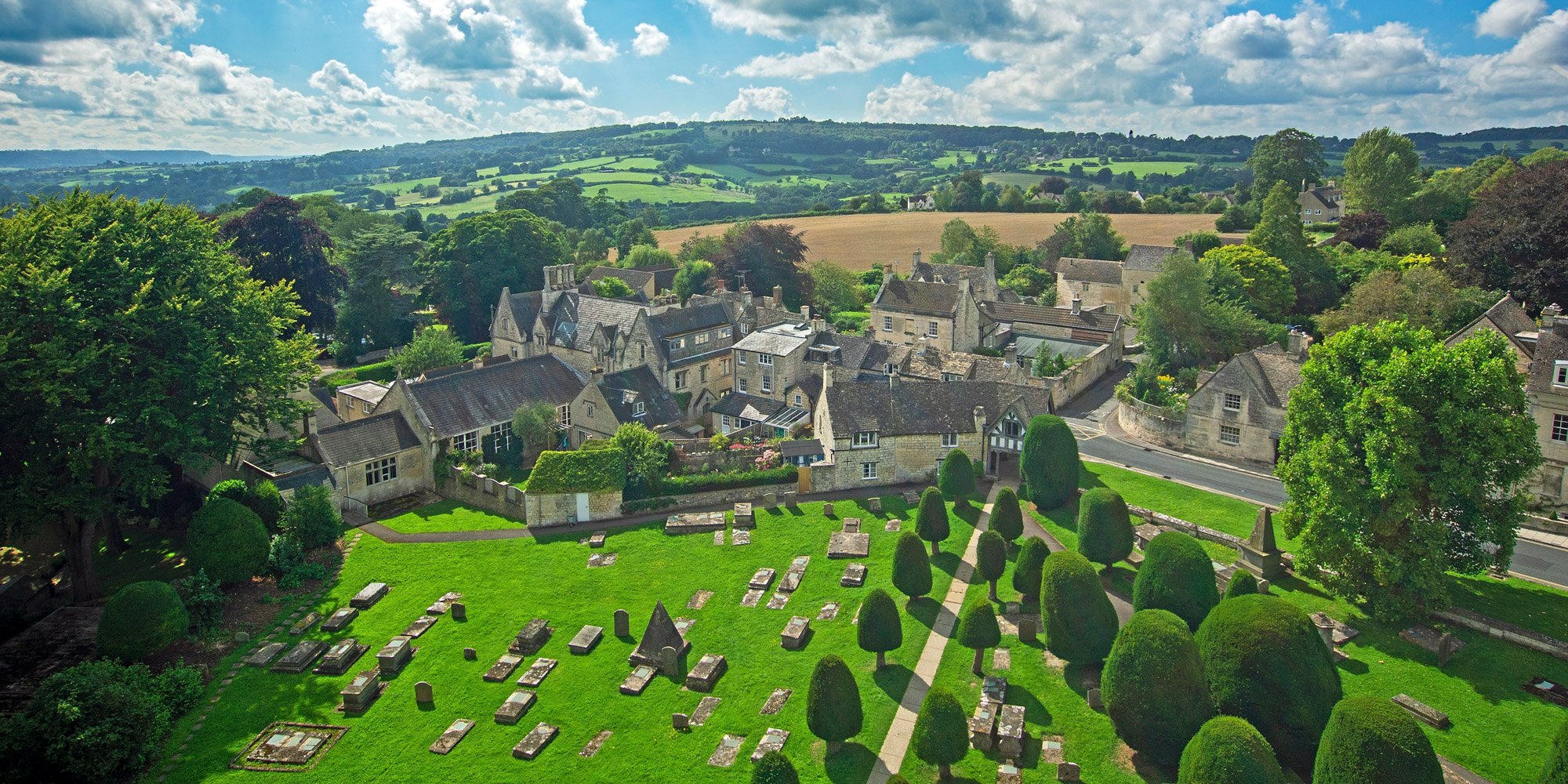
Start in the square itself, which still hosts a market, and where the medieval stocks stand in one corner (currently away for repair, a small civic drama that has been tracked by locals since last year). Two Charter Fairs are still held here each May and October, a right granted by Edward IV in 1476, alongside the Gypsy Horse Fairs that fill the town with traders each spring and autumn, worth timing a visit around, if only to see the square doing the job it was built for.
The Tolkien Door
Just off the square, down the narrow passage beside St Edward’s Church, is the doorway that gets photographed more than anything else in Stow: a pointed arch flanked by two ancient yew trees whose roots have grown up and around the frame over the centuries. It’s widely, if unofficially, credited as the inspiration for the Doors of Durin in The Lord of the Rings, Tolkien is known to have spent time in the area, and it costs nothing to stand in front of it for five minutes, which is about as long as most people can resist reaching for their phone.
Where to Stay
For lunch or a bed for the night, The Porch House on Digbeth Street is the obvious stop and a genuinely strange building to be inside: its timbers have been carbon-dated to around 1000 AD, and local tradition holds that it began life in 947 as a hospice founded by the Saxon Duke Athelmar, later passing to the Knights Hospitallers. The current porch was added by Thomas Shellard in 1615; a fireplace in the dining room carries witch marks scored into the stone to ward off evil, and renovation work uncovered a pit beneath what is now the restaurant, thought to have been used for blood sports. All of which is to say: order the Sunday roast and take a proper look around while you’re there. The Old Stocks Inn, on the square, is the newer alternative - sixteen rooms and a walled garden, done in the pared-back, kilim-and-linen style that has become the house style of Cotswolds hotels generally, but done well.
Where to Eat
For food with fewer beams and more ambition, The Old Butchers on Park Street specialises in rare cuts, seafood and a serious wine list; The Sheep on Sheep Street does wood-fired sourdough pizza in a seventeenth-century building; and The Queen’s Head, a Donnington Brewery pub on the square, is as straightforwardly good a village pub as the Cotswolds still produces. Huffkins, also on the square, has been baking since the seventeenth century and remains the right place for scones.
Antiques and Galleries
Antiques are Stow’s other trade, and the shops here are dealers’ shops rather than gift shops: Tara Antique Centre and Tudor House both hold multiple vendors under one roof, worth an hour’s browsing rather than a quick circuit, while Styles of Stow specialises specifically in antique clocks, ticking away in a way that makes the whole shop faintly disorienting. The Red Rag Gallery on Church Street and the Fosse Gallery show contemporary British painting and sculpture for anyone whose interest runs less to furniture.
Walks and Days Out
Beyond the town, the walking is some of the best in the Cotswolds: the Heart of England Way and the Gloucestershire Way both pass through, and a two-hour circuit takes in Upper and Lower Slaughter, whose footbridges and millponds are rather gentler than their names suggest. Batsford Arboretum and the gardens at Sezincote are both within a short drive, as is Daylesford, for anyone who wants to end the day exactly where every other Cotswolds day seems to end.
A Market Town, Still
Stow doesn’t reinvent itself for visitors, which is precisely its appeal: it has been a market town since before most English towns had names for the job, and it continues to behave like one no matter which celebrity decides to pop in for a coffee.