

Published: 28 April 2026
Founded in London in 2016 by Gary Stanesby, after his time as a senior partner at Purcell, Stanesby studio works across high-end residential, hospitality, heritage and cultural projects. On paper, that can sound broad. In reality, the work is quite focused. Again and again, it comes back to one question: what does this building need, and what can be left well alone? That idea runs through the practice’s own description of its work, which stresses a bespoke approach, heritage experience and a softer hand with sensitive buildings. Gary Stanesby puts it more plainly: ‘Good architecture is about letting a site or building be true to its setting, purpose and use.’
How Far Is Too Far
That line tells you a lot. The practice is not trying to impose a house style in the obvious sense. There is no single trick. No one big flourish. What it seems interested in instead is pressure. How far can a building be pushed before it stops feeling like itself? How do you make an old house work harder without flattening its character? How do you add comfort, light and modern infrastructure without getting carried away by your own intervention?
That is harder than it sounds. Especially in London, where so much high-end residential work sits inside listed buildings, conservation areas and difficult planning conditions. Stanesby is unusually well placed for that kind of job. The practice states that retrofitting existing buildings is central to its approach to net zero, and that it has particular expertise in historical and listed buildings. That matters. Retaining and adapting older buildings is now widely understood to be a better carbon choice than demolition and rebuild, because it preserves the embodied carbon already locked into the structure. Historic England’s recent guidance makes that case directly.
So when Stanesby talks about breathing new life into heritage assets, it is not just aesthetic language. It is increasingly the practical argument too.
Palace Green
You can see that attitude clearly in Palace Green in Kensington, one of the practice’s most telling projects. The scheme involved the renovation and extension of a Grade II private house, reworked to include five apartments and a detached mews house. What is interesting is not just the fact of the conversion, but the method. According to the practice, the new-build elements were developed through research into Philip Webb’s design principles, using contemporary brick detailing and hand-crafted materials to connect old and new. It would have been very easy for a project like this to become a heavy-handed heritage exercise, full of period theatre or self-conscious contrast. Instead, the idea seems to have been to stay in conversation with the original building, rather than compete with it.
Hyde Park Gate
That same discipline appears in Hyde Park Gate, a detached house on a private road near Kensington Palace. Stanesby handled planning, detailed design, interiors and delivery. The project is large and unapologetically rarefied: reception rooms, generous bedroom suites, a spa, an 18-metre pool, cinema, gym, games rooms, guest and staff accommodation.
In less careful hands, that kind of brief can tip quickly into nonsense. What makes it notable is the way the practice frames it. The house is presented not as an excuse for excess, but as a complex planning and design exercise shaped around circulation, structure and use. The practice describes it as one of the last major double-basement developments permitted in the Royal Borough of Kensington and Chelsea, which is significant in a borough that tightened its basement rules years ago through specific planning guidance. In other words, this is not luxury for luxury’s sake. It is luxury under pressure, and under rules.
Lancelot Place
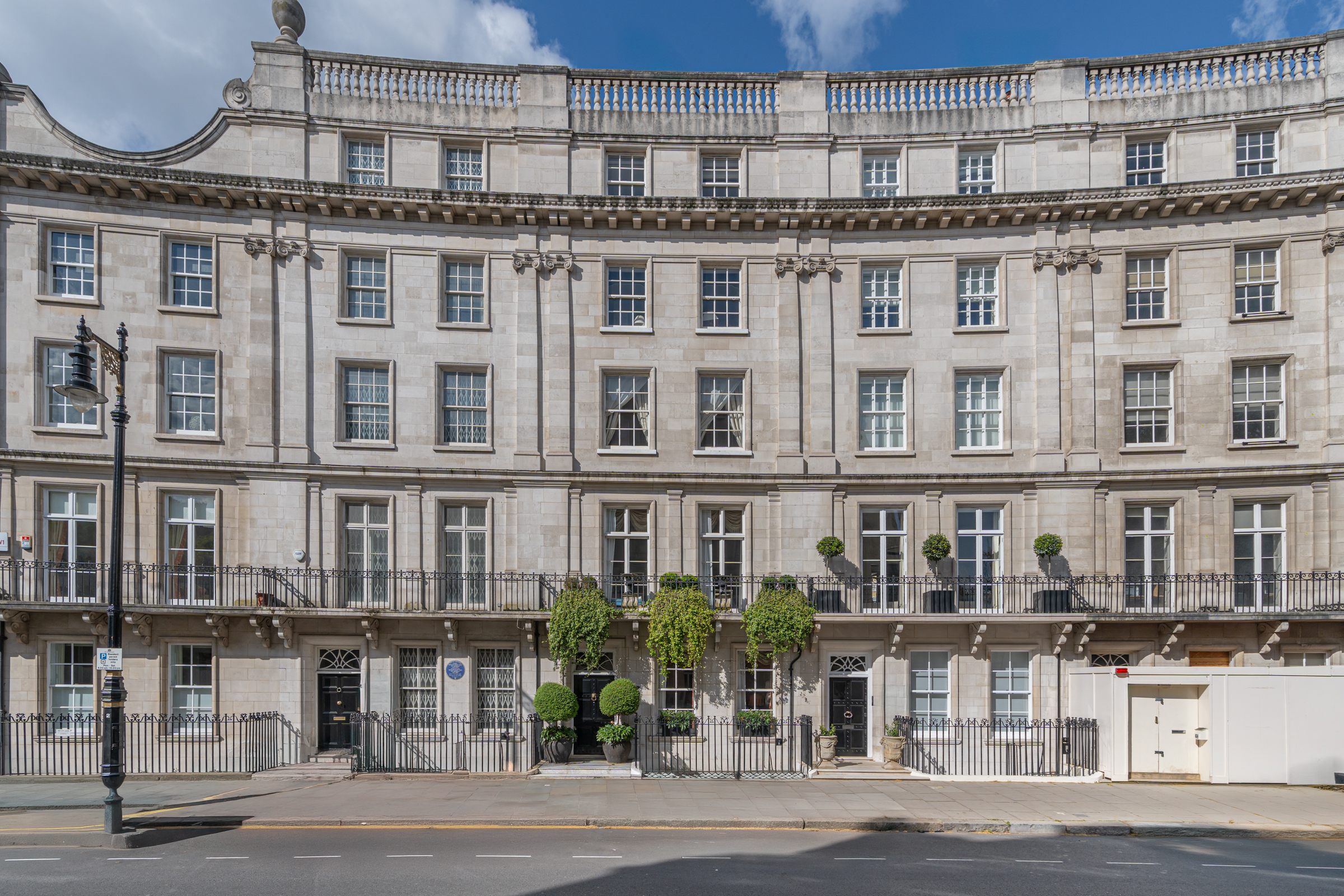
Then there is Lancelot Place in Knightsbridge, a new-build row of five seven-storey townhouses in a conservation area, just by Harrods. This is different ground. No historic house to restore. No Arts and Crafts lineage to pick up. No old fabric to work around. And yet the same questions apply. How do you build something new in a place that is already visually crowded with wealth, status and architectural ego? Stanesby’s answer seems to be restraint. The houses are stone-fronted and urban, designed to slot into one of the most scrutinised neighbourhoods in London without becoming crude statements.
Against the Noise
What stands out across these schemes is that the practice seems more interested in substance than style. That may sound old-fashioned, but it is not. In fact it feels more current now than a lot of the visual noise that has dominated domestic architecture for the past decade.
There has been a glut of houses that perform contemporary living in a rather tired way: overglazed, overlit, overdesigned. Stanesby’s work suggests a different set of priorities. Let the plan do the work. Let the materials earn their place. Let the building hold onto some dignity.
Beyond Residential
Even the practice’s move into cultural work follows that line. Its ongoing feasibility study for Hastings Contemporary is about reconnecting the gallery to the urban and social fabric around it. That phrase could easily read like consultancy filler, but in the context of the wider portfolio it makes sense. This is a studio that seems to think buildings are part of a setting before they are part of a brand. The setting may be a private road in Kensington, a conservation area in Knightsbridge or a public-facing gallery in Hastings. Either way, the instinct is similar. Start with what is there. Pay attention. Do not overstate your case.
The Value of Judgement
That, really, is why Stanesby Architecture is worth looking at now. The studio has confidence to let a building keep its own voice and the good sense to know that in domestic architecture, especially in England, the smartest move is often not invention but judgement. That may not be the easiest thing to photograph. But it is usually what makes a house last.