

Published: 16 April 2026
In the worlds of art, design and architecture, there is always a primary source. Originality is often concerned with taking the seeds of influence and building upon them in new and remarkable ways that will, in turn, make their own history. For architecture, this has always been the case. When the ideas, shapes, forms and engineering marvels of Roman architecture are considered, one can see its influence everywhere in the modern world.
Rome is a civilisation that was crystallised in the Republic around 500 BCE and ran to the height of an Empire in the early 4th Century CE. It was defined by power, scale, innovation and precision and its architecture and legacy are simply inescapable.
Enabled by the Etruscans
Roman architecture was not created in a vacuum of ideas, of course. It too borrowed, stole and reiterated what had come before in numerous and obvious ways. The building technologies and methodology of the Etruscans that occupied Italy from around 900 BCE literally provided the foundations on which Rome was built. Crucially, they gave Roman architects the arch, wedge-shaped stones that distributed weight in incredible ways to span massive spaces more efficiently and beautifully than before. This central tool was applied by the Romans to build aqueducts, bridges, vaults and domes that looked to the population at the time like divine creations of awe and majesty. The Etruscans also informed the massive urban planning and infrastructure that made Rome famous, beginning sewer systems and town layouts that Roman architects so efficiently mastered.
Odes to Greece
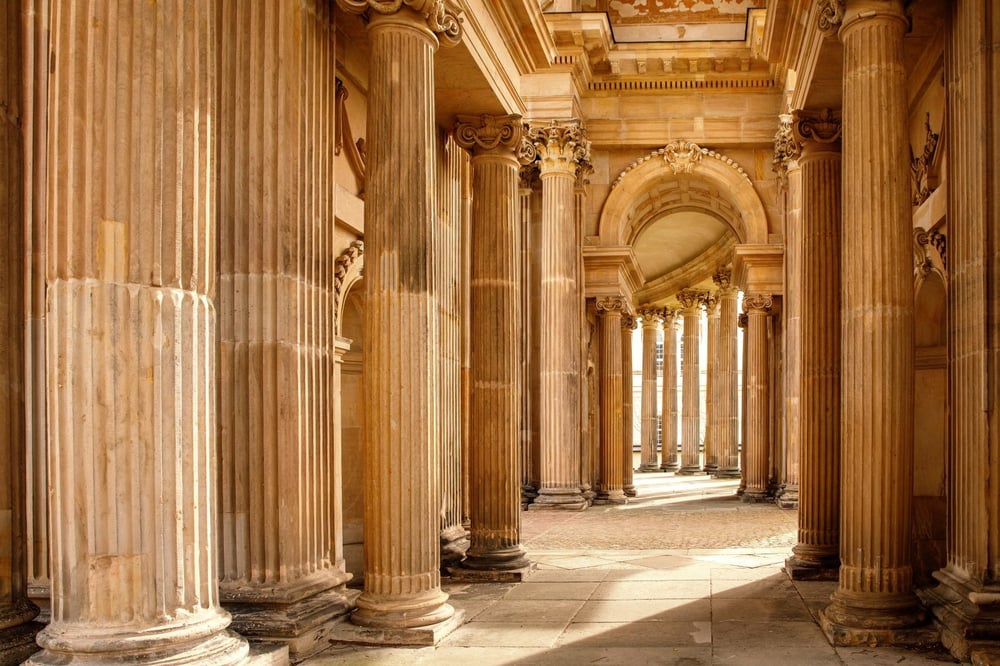
If it is true to say the Etruscans taught Roman architects how to build, then it follows that the Greeks showed them how to make their buildings speak to people in a language of power, poetry and progress. Greek architectural ideas of balance and reason that could be employed towards the pursuit of perfection captivated Rome and its builders. The three formal orders of Doric, Ionic and Corinthian that held up Greek architecture were therefore adopted by the Romans wholesale. These strict proportional building systems that were used with such restraint and elegance in Greece were redefined as decoration, with the greatest example being the stacks of columns used at The Flavian Amphitheatre, completed in Rome in 80BCE, that eventually became known forever as The Colosseum.
This iconic structure has Doric columns at ground level, Ionic on the second and Corinthian on the third. Significantly, none of these columns are load-bearing. They represent the development of civic architecture in Rome, taking what it admired from the past to use as dressing and sculpture, safe in the knowledge that their new power and structure was now unmatched anywhere in the world.
Strength. Function. Beauty
The approach to Roman Architecture was encapsulated by the 1st century writer, engineer and architect Marcus Vitruvius Pollio. Vitruvius famously stated in Book I of his De Architectura that ‘all buildings must have three attributes: firmitas, utilitas, venustas.’ The simplest translation of which means everything in the built environment should be strong, have a clear function and be beautiful.
His work systemising the theory, knowledge and practice of Roman architecture is present in all the vaults, arches and public works that would shape cities and landscapes all over Europe and farther afield for centuries to come.
Concrete Evidence
The use and development of emerging building materials in Roman architecture was perhaps just as important as the methods they employed. It is not hyperbole to suggest that an engineering revolution took place on an industrial scale that was integral to their empire building.
Undoubtedly, the greatest of all their material innovations was the use of opus caementicium or Roman concrete. The most important element of this new wonder-material was the volcanic ash or Pozzolana, found in the bay of Naples, which was mixed with lime mortar and aggregate. It would then be placed between walls or wooden formwork until it set, growing stronger over time.
Roman concrete fundamentally changed what was possible to build. Following early experiments in 200 BCE, it became ubiquitous in the Imperial period of the 1st and 2nd centuries, allowing architects to shape space in unprecedented ways. They could now build faster at a scale never seen before. Crucially, it could also be set underwater, allowing for the vast maritime constructions that were so important for the Roman military. The key Roman ports of Pozzuoli and Portus employed extensive submerged structures, including breakwaters and foundations poured directly into the sea.
Domes & Vaults
The immense 43.3 metre wide dome of the Pantheon, completed in 126 CE, is a preserved testament to the alignment of developed ideas and new materials in Roman architecture. Almost two thousand years later, it remains the largest concrete dome in the world without reinforcement.
This incredible architectural achievement is ruled by one ultimate aim of creating a perfect hemisphere sat on a cylinder. The weight of the dome moves downwards and outwards with no point loads, and the sheer power of compression works to keep it stable. When Emperor Hadrian commissioned the structure, it was a symbol of his own intellectual and philosophical might. Not only would Rome be recognised as an all-conquering military power, they would also be setting a new course for civilisations to follow in terms of cultural and artistic developments.
Domestic Expression
One of the most notable aspects of Roman architecture was the attention it paid to spaces for daily life too. Away from the monumental temples and grand civic structures, the Domus of wealthy urban homes were given form and order. They were organised around a central atrium to encourage family life and social transactions to happen in open spaces. The evidence from such fascinating archaeological sites as Pompeii and Herculaneum offers clues to the domestic environment, shaped by decoration with art as part of every home and the human experience considered through movement, circulation and light.
A Lasting Legacy
The enduring impact of Roman architecture can never be overstated. The innovations and experiments that they toiled over and refined through thousands of years has allowed new civilisations and societies to build reliable infrastructure in rapid time frames, to a huge scale. It is quite simply the foundation of Western architectural thought that gave life to every design era for the built environment that came after it. The homes, offices and public spaces that we all live and operate in in 2026 are certain to owe the Roman architectural pioneers a debt in one way or another. Indeed, the ideas that spread from the Empire to the everyday may very well be Roman architecture’s most important legacy.