

Published: 24 June 2026
Whether through news footage, postcards, or the chime of Big Ben, The Palace of Westminster holds a global profile that few civic buildings can match. Yet the palace is not just a landmark or tourist attraction, but an active political environment with over a thousand years of institutional memory, whilst still shaping daily governance. On the north bank of the River Thames in central London, the palace is the home of the UK Parliament, and a building that links medieval monarchy to modern democracy.
From Royal Residence to Seat of Power
This patch of land was already important long before the towers and stone carvings recognised today. The site was originally part of Thorney Island, an area that gradually became a focal point for royal and religious life. In the 11th century, Edward the Confessor set up a royal palace here, next door to Westminster Abbey and at the time, it made sense. It was close to the river, removed from chaotic city life, and with plenty of space to build something impressive. For a few centuries, Westminster was less about politics and more about monarchy. Kings lived here, and Royal business happened here. But by the late 1200s, it was also associated with governance, hosting the Model Parliament of 1295 under Edward I. By the late 13th century, this marked a significant moment in the development of parliamentary representation, embedding Westminster into the political structure of the country.
The Fire That Wiped the Slate Clean
In 1834, much of the original medieval complex was lost to a fire, and the palace as it exists today is largely the result of that disaster. Although Westminster Hall remained, the government wanted a replacement building and Architect Charles Barry was selected to lead the project, working closely with Augustus Pugin. Barry handled the structure and layout whilst Pugin brought the personality, insisting on a Gothic design with medieval aesthetics. Construction began in 1840 and continued for decades, with both men dying before its full completion. The Gothic Revival style was not all about beauty, it was about messaging. At a time of rapid industrialisation, the design conveyed tradition, authority and continuity. The result of the rebuild was a palace that felt ancient, even though much of it dates from the 19th century.
Survivals from the Medieval Past
Despite the scale of the Victorian rebuild, parts of the original palace remain. Completed in 1099 under William II, Westminster Hall is one of the oldest surviving parts of the entire complex. Added in the 14th century, its hammerbeam roof is one of the great achievements of medieval engineering, and underneath it remains one of the few spaces in the palace where the medieval atmosphere is still fully present. This is where major moments in British history have played out. Coronation banquets were once held here, state trials took place, and figures such as Charles I were brought to the hall to be tried.
Where Design Meets Function
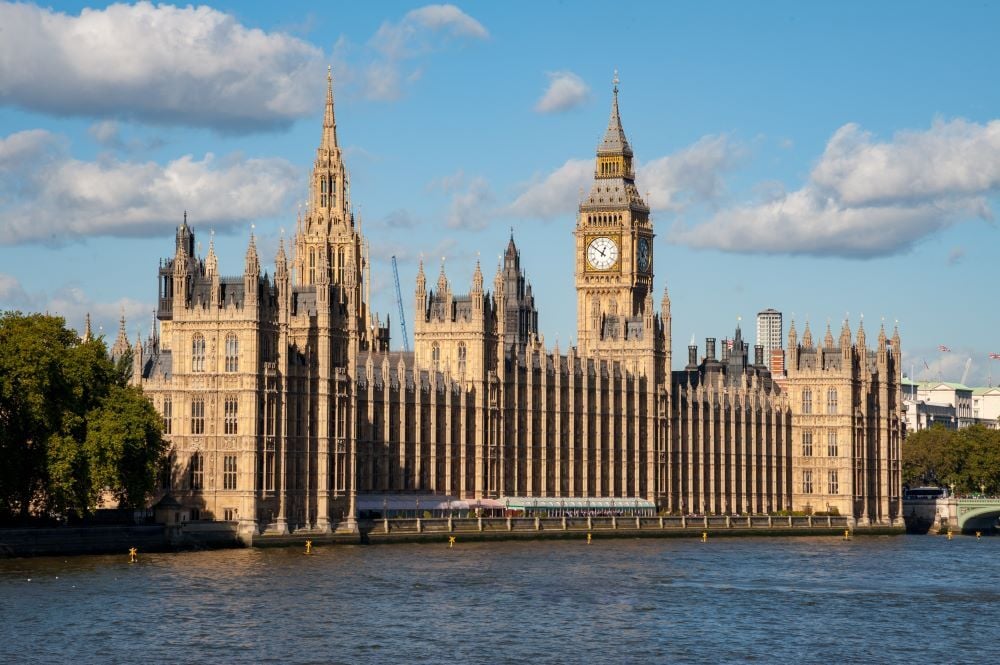
The palace’s riverside front runs for hundreds of metres and is broken up by towers, pinnacles and repeating vertical lines. At either end are its most recognisable features. To the north is the Elizabeth Tower, better known as Big Ben, and to the south is Victoria Tower, which was amongst the tallest square towers in the world when it was completed. Between them, The House of Commons and the House of Lords sit at opposite ends, linked by corridors and ceremonial spaces. The Lords is richly decorated, whilst the Commons is more pared back, reflecting its role. The architecture doesn’t just frame Parliament, it reflects how it operates.
A Working Parliament
It is easy to think of the palace primarily as a historic monument, but for all its grandeur, the building has a practical job. The elected MPs sit in the House of Commons where most of the noise happens with debates, questions and disagreements. that can range from quietly procedural to unexpectedly dramatic. In the House of Lords, laws are debated, scrutinised and enacted, often under intense public and political pressure. What is striking is how much of this takes place within a building that was never designed for modern life. Instead, it continues to adapt to political life, even as its physical structure shows the strain of age and constant use.
World Status, Symbolism and Stories
In 1987, the palace, together with Westminster Abbey and St Margaret’s Church, was given UNESCO World Heritage status. This recognition reflects not only its architectural value but also its historical importance. UNESCO identifies the site as illustrating the development of parliamentary democracy and the relationship between church and state. The Palace of Westminster is also known worldwide for Big Ben, which refers not to the tower but to the bell within it, first rung in 1859. Its chimes have since become one of the most recognisable sounds in the world. Then there are the moments that feel almost out of place. In 1812, Prime Minister Spencer Perceval was assassinated within its precincts, and was the only British prime minister to suffer such a fate.
A Building in Tension with Time
Today, the palace faces a different challenge. The building was not designed for modern times, and the years of constant use combined with the challenges of maintaining a vast Victorian structure have made restoration unavoidable. The building is not a museum and cannot simply be closed for works, which has led to an ongoing debate over how to preserve it without disrupting the work that takes place inside.
This tension between preservation and practicality is part of what makes the Palace of Westminster so compelling. Decisions made inside still shape the country, debates still unfold in real time, and traditions are still followed. At The Palace of Westminster, history is not just remembered. It is constantly being made, argued over, and occasionally rewritten. The building’s Gothic exterior may suggest permanence, but its identity lies in its activity.