

Published: 23 July 2026
History lurks in every corner of London. It is difficult to wander the city without stumbling upon a heritage building every few yards; from local groceries and banks to the average family home, almost every structure and facade bears testimony to the capital's storied past. It is no wonder that London leads the charge in adaptive reuse, a practice wherein historic buildings are sensitively converted for contemporary purposes while their original character is preserved.
Nowhere is this more visible than in the capital's event venues, many of which occupy grand residences that once served as the addresses of aristocratic families and luminaries of the time. Read on to discover some of London's most remarkable historic homes now operating as event venues for private celebrations and corporate gatherings.
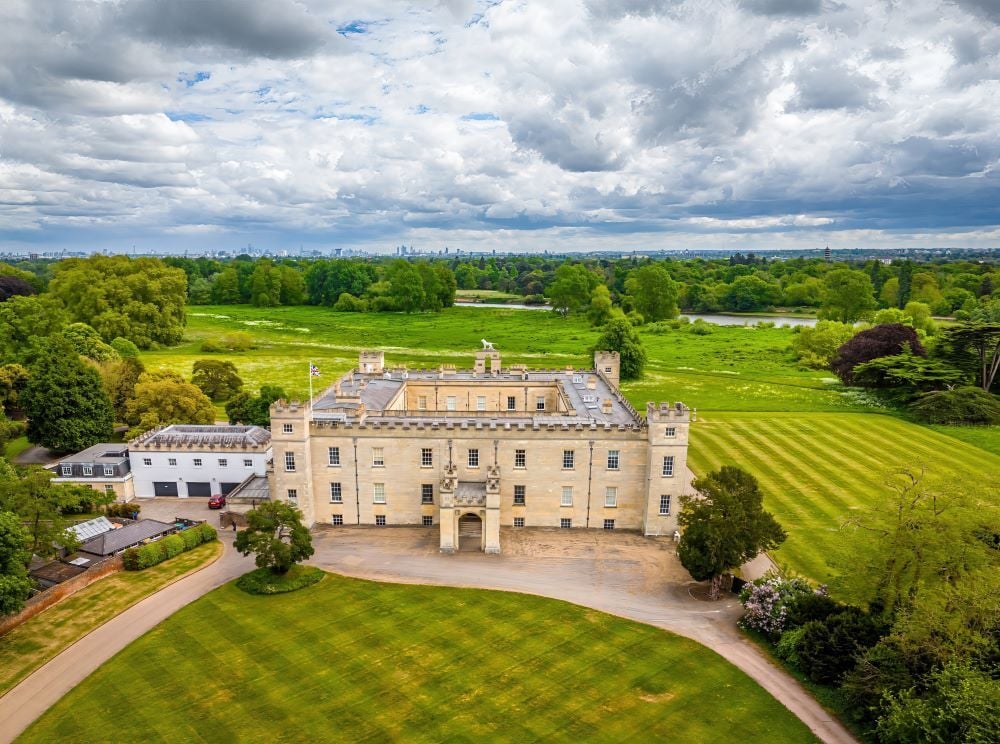
1. Syon House
Syon House takes its name from Syon Abbey, a Bridgettine monastery founded in 1415 by Henry V on a nearby site. Among the most prosperous religious houses in England, it was dissolved under Henry VIII in 1539. The site was eventually acquired on long lease by the 1st Duke of Somerset, who rebuilt it as a private residence in the Italian Renaissance style. It was then taken over in 1594 by Henry Percy, 9th Earl of Northumberland, and has remained the family seat ever since.
The most significant transformation came in the eighteenth century, under the auspices of Hugh Smithson and Lady Elizabeth Seymour Percy. Landscape architect Lancelot 'Capability' Brown replaced the formal gardens with sweeping parkland. Scottish architect Robert Adam was engaged to create a series of classical interiors filled with antiquities brought from Italy, a commission now regarded as the founding expression of what became known as the Adam style.
Working within the constraints of the existing structure, Adam produced five principal state rooms incorporating marble chimneypieces, fluted columns with Corinthian capitals, and an elaborate programme of neoclassical decoration drawing on Roman antiquity and his studies at Pompeii. Among the standout spaces is the Long Gallery, stretching 14 feet wide and 14 feet high, its thick walls lined with recesses and niches for books and its surfaces finished in delicate stucco work.
In the nineteenth century, further additions were made to the estate, including a grand porte-cochère and the Great Conservatory, which was among the first of its kind to use cast iron and glass construction.
Today, ongoing restoration by Northumberland Estates has seen the house re-roofed, its masonry repaired, and the state rooms returned to their original Adam colour schemes. The estate is now available for private hire for a wide range of events, including weddings, civil ceremonies, corporate dinners, and large-scale parkland gatherings across its 200 acres. The house and grounds have also featured in productions such as Gosford Park, Killing Eve, and Bridgerton.
2. Two Temple Place
Two Temple Place was built in 1895 for William Waldorf Astor, founder of the Waldorf Astoria in New York and one of the wealthiest men of his age. Having settled in England, Astor sought a building to serve as both a private residence and an estate office. The architect was John Loughborough Pearson, who is widely considered the founder of Modern Gothic architecture. He designed the building in the Early Elizabethan style, constructing the exterior entirely in Portland stone. The facade also bears elaborate carvings by Nathaniel Hitch. Above the crenellated parapets, a gilded weather vane in the form of Columbus's caravel, the Santa Maria, was installed to symbolise the transatlantic heritage of the Astor family.
The interiors are among the most ornate in London. Decorator John Dibblee Crace finished the rooms in the French Renaissance style, with walls panelled in precious wood and ceilings gilded throughout. The entrance hall floor was laid in opus alexandrinum, a decorative inlay style using marble, jasper, porphyry and onyx set in geometric patterns. The main staircase, carved in oak and mahogany by sculptor Thomas Nicholls, features newel posts bearing figures from The Three Musketeers, which was apparently Astor's favourite novel.
The Great Hall is the most elaborate space in the building. Its walls are clad in pencil cedar and rise 35 feet to a hammer-beam roof in carved Spanish mahogany. Running below the roofline is a gilded frieze of 54 portrait heads of figures from history and fiction, among them Pocahontas, Anne Boleyn, and Marie Antoinette.
Now managed by the Bulldog Trust, a charitable organisation, the building opened as a public gallery in October 2011. It was the first London venue dedicated to showcasing publicly owned art from regional collections across the UK. The building is also available for private hire for weddings, private dining, receptions, product launches, and filming.
3. Van Gogh House
87 Hackford Road is a Georgian terraced house in South London where Vincent van Gogh lived between August 1873 and September 1874. His time in London had a profound impact on his practice later in life, as it was here where he fully immersed himself in British literature and art.
Interestingly, Van Gogh wasn’t linked to 87 Hackford Road until 1971, when postman and ardent Van Gogh admirer, Paul Chalcroft, took on the burden of locating the artist’s precise address during a postal strike. At the time of discovery, the house was occupied by Arthur and Marjorie Smith, a couple who had moved in during the 1950s and were astounded at the fact that their humble abode was once the address of the legendary artist.
By 2012 the Grade II-listed building had fallen into near dereliction when it was rescued and subjected to a major conservation project. The ambition was not to create a museum but to keep the house functioning as a home, allowing it to remain in practical use while also serving as a venue for artist residencies and exhibitions. It opened in 2019 and now hosts a programme of exhibitions, residencies, and guided tours. The house is also available for private hire and filming.
4. Strawberry Hill House and Garden
Strawberry Hill House in Twickenham was built by Horace Walpole from 1749 onwards and is widely regarded as the prototypical example of the Gothic Revival in English architecture, with a credible claim to being the starting point of the movement. Walpole, a writer and collector, transformed a modest cottage into his "little Gothic castle", working in stages over several decades with fellow amateur architect John Chute and designer Richard Bentley.
The exterior evolved without a fixed plan, accumulating battlements, towers, and turrets over successive phases, with the final stage completed in 1776 to designs by architect James Essex. Inside, Walpole introduced gilded ceilings, grand fireplaces, enamelled door handles, carved wooden screens, and coats of arms of men he pretended were his mediaeval ancestors, all conceived as settings of Gothic atmosphere for his extensive antiquarian collection. He referred to this quality as "gloomth", keeping the gardens deliberately cheerful in contrast.
After passing through several hands following Walpole's death in 1797, the house was ultimately acquired in 1923 by St Mary's University College. Following a £9 million restoration, it reopened to the public in October 2010. It is now recognised as Britain's finest example of Georgian Gothic Revival architecture. The house is available for private hire for weddings, corporate events, and filming, with an active calendar of exhibitions and public events throughout the year.
Final thoughts
London's heritage buildings are far more than relics of the past. Whether it is the grandeur of Syon House, the Gothic fantasy of Strawberry Hill, or the quiet intimacy of Van Gogh's Brixton lodgings, each of these spaces carries a living history that no purpose-built venue can replicate. Adaptive reuse ensures that this history remains accessible, allowing the city's architectural legacy to continue evolving rather than simply endure. For those seeking a setting that offers something beyond the ordinary, London's historic venues make a compelling case that the past is very much open for business.