

Published: 3 April 2026
For anyone who has spent years in London, country life in the UK can feel slightly mythologised until you actually do it. It tends to conjure up a familiar image: dogs by the Aga, children in muddy wellies, roses around the front door, something slow-cooked in the oven. The reality is less polished and, in many ways, more appealing. Certainly, there are school runs, village fêtes and the occasional awkward reverse outside a farm shop. But what country life really offers is something more useful than the fantasy: space, calm and a way of living that feels less squeezed.
That is usually what people are looking for when they begin to consider life beyond the city. Not just more square footage, though that is part of it, but a different pace to everyday life. One where there is more room around everything, where home extends beyond four walls, and where the day does not feel quite so tightly packed.
A Greener Atmosphere
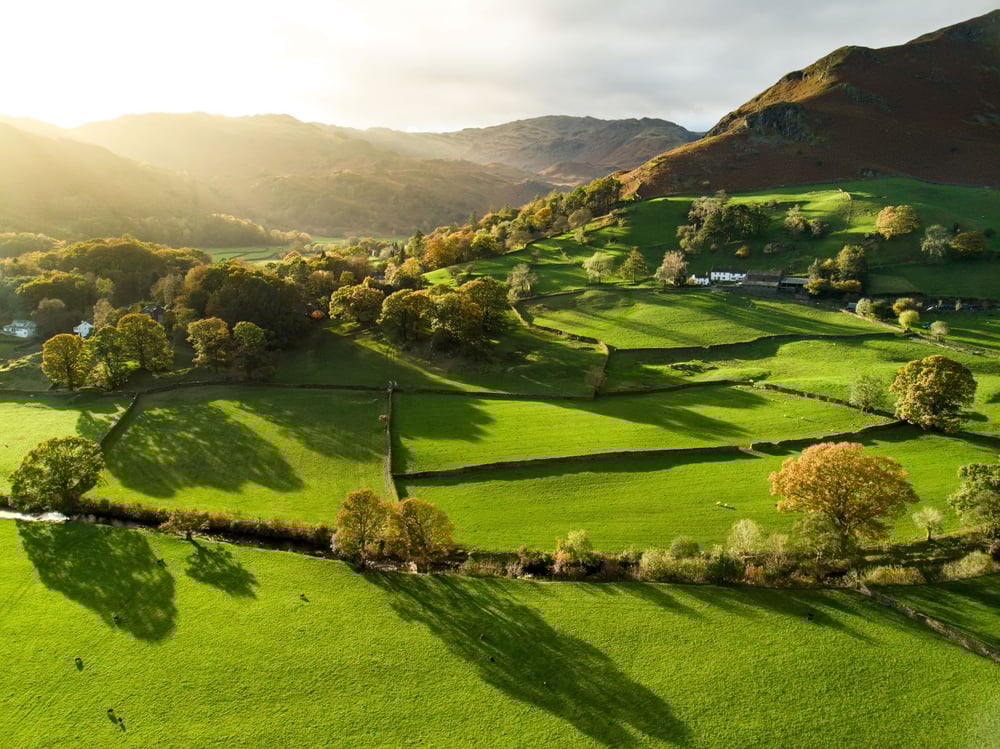
The British countryside lends itself particularly well to that shift. It is not dramatic in the way that Tuscany or the South of France can be, and that is part of the appeal. It is gentler, greener and easier to settle into. There are rolling hills, ancient woodland, hedgerows, villages built around pubs and primary schools, and a landscape that changes quietly with the seasons. Spring brings blossoms and cow parsley; summer stretches out in long green weeks; autumn is all low light, chestnut trees and smoke in the air. In winter, if the house is right, there is nowhere better to be.
And the house matters. A great deal.
Homes in Harmony with the Landscape
One of the pleasures of country living in the UK is the range of homes available. There are Georgian rectories with proper proportions, converted barns with generous volume, Victorian villas on the edges of market towns, cottages with beams and uneven floors, and contemporary houses that sit comfortably in the landscape. The best of them feel anchored to where they are. They are not simply houses placed in the countryside, but homes that make sense within it.
That connection to the landscape is often one of the first things people notice when they move out of a city. In London, green space is something you go to. In the countryside, it becomes part of the day without much effort. You walk more, often without planning to. Dogs get longer outings. Children spend more time outside by default. Even a quick coffee in the garden feels like a normal part of the morning rather than something you have had to carve out time for.
There is also, increasingly, a buyer who wants the country without the clichés. Less performance, more thought. They want character, certainly, but they also want underfloor heating, strong broadband, a proper pantry and a kitchen that works. Country homes have become more design-aware, but the most successful ones still feel relaxed rather than overly curated. The point is not perfection; it is ease.
Where Family and Community Life Merge
For families, this is often where the appeal becomes most tangible. Country life in the UK is not just visually appealing, though that helps. It is also straightforwardly practical. Houses tend to be larger. Inside, space is usually arranged in a way that reflects how people actually live. Kitchens are larger because they need to be. Utility rooms are essential rather than aspirational. Boot rooms earn their keep almost immediately. Gardens are more generous. Storage is less of a negotiation. Children can have bedrooms that are not also homework corners, and spare rooms can actually function as spare rooms. There is often enough outside space for football goals, a trampoline, a dog and a slightly overambitious vegetable patch all at once.
There is space for coats, school bags, muddy shoes, dogs, laundry and all the inevitable clutter that builds up over the course of a week. The best interiors reflect that reality. They are not overly styled, but comfortable and well judged. Painted joinery, old tables, proper lamps, books, durable fabrics and furniture designed to be used rather than kept for show.
What often shifts most, however, is the feel of family life itself. Life becomes more local and, often, more connected. There are school gates, village WhatsApp groups, cricket clubs, farm shops and pub gardens full of familiar faces. If you are used to the anonymity of city living, it can feel a little exposing at first. But for many families, that sense of community becomes one of the main reasons they stay.
Exceptional Education Within Reach
School catchment, unsurprisingly, is a large part of the conversation.
Across the UK, many of the most desirable country areas are shaped as much by education as by architecture or scenery. Strong village primaries, well-regarded state secondaries and proximity to sought-after independent schools all have a real influence on where families choose to buy. In many cases, a house is valued not just for its acreage or proportions, but for the school run it quietly solves.
That is particularly true in established family areas and popular commuter belts, where school catchments are discussed with almost the same focus as kitchens. Certain postcodes carry weight because of what they offer access to. Families will move for a catchment area with the same determination others reserve for sea views or private parking. It may not be the most romantic part of the picture, but it is one of the reasons country life in the UK works so well. It is not all beams and open fires. Much of the appeal lies in how well it supports everyday life.
That balance between appearance and practicality is where the best country homes tend to stand out.
Connected to Urban Heartbeats
One of the reasons country life in the UK has become so appealing is that it no longer requires the same level of compromise. Many of the most attractive rural and semi-rural areas remain within easy reach of London and other major cities, making them workable for hybrid schedules and flexible working. The result is a more fluid way of living: time in town when needed, and more space at home the rest of the week.
That shift has had a clear effect on the property market. Buyers are no longer simply looking for a charming house in a pretty village. They are looking for homes that can support a full life: somewhere to work, host, raise children, accommodate guests and still feel slightly removed from the pace of the city. In that sense, country life has become less about escape and more about quality of life.
Final Thoughts
Ultimately, experiencing country life in the UK is about more than the image often attached to it. At its best, it offers something quieter and more useful than that. Space, a bit more time, and a way of living that feels easier to manage day to day.
And once you have had breakfast looking out onto a garden rather than the building opposite, the appeal tends to speak for itself.