

Published: 13 October 2026
From honey-coloured Yorkstone on Sloane Street to a greener Hans Crescent, London's grandest shopping quarter is discovering that the space between its buildings matters as much as what lies behind the shop windows.
For most of its modern life, Knightsbridge has been judged from the inside. Its reputation was made in the food halls of Harrods, the fitting rooms of Harvey Nichols and the quiet drawing rooms of the garden squares behind Brompton Road. The pavements outside were something to be endured – narrow, crowded and cluttered with bollards and the occasional telephone box that no longer held a telephone – on the way from one beautiful interior to the next. That is changing. Over the past few years, the district's landowners have begun to treat the street itself as a room worth furnishing, and the results are starting to show.
A boulevard for Sloane Street
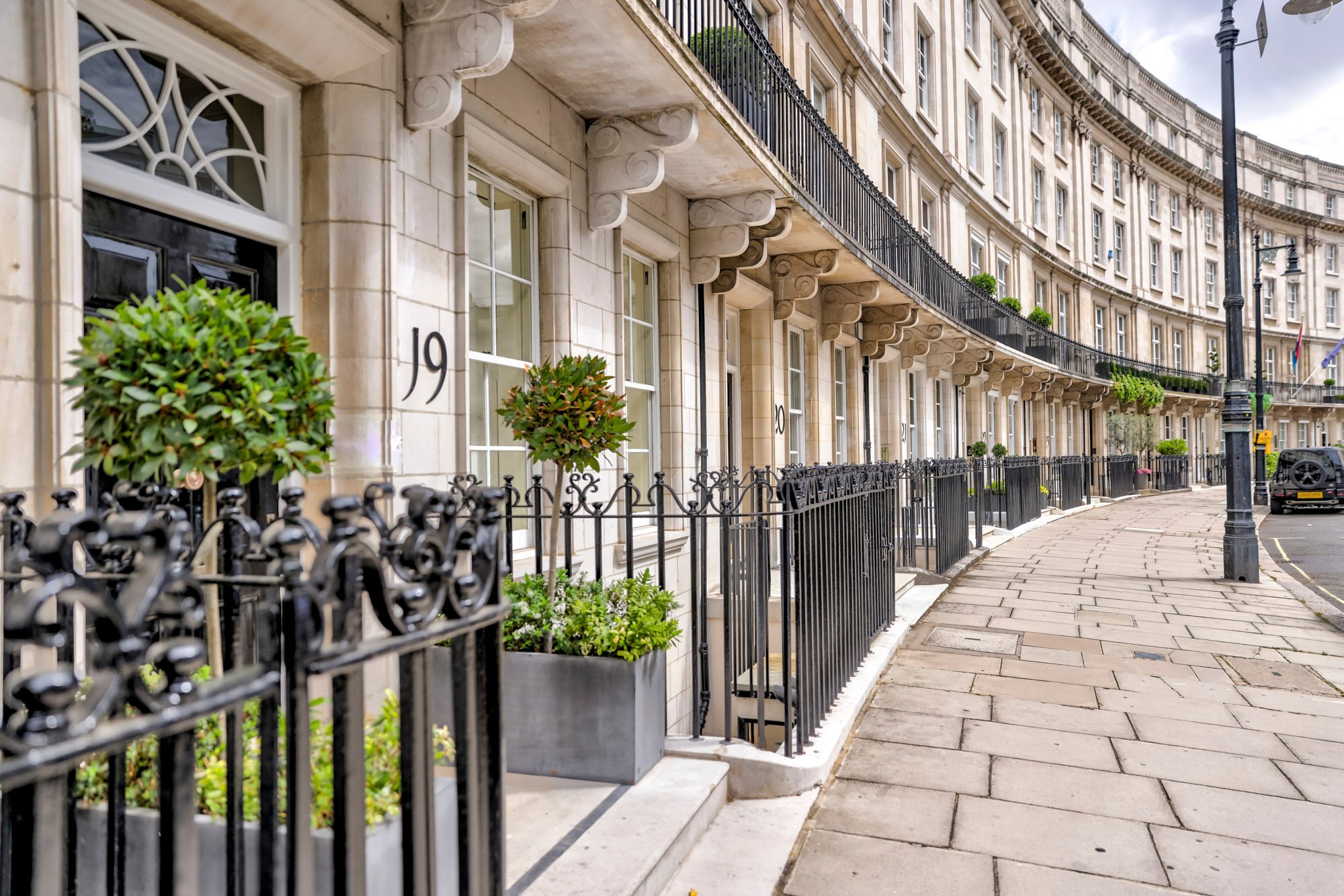
The most visible evidence is Sloane Street. Cadogan's £46 million transformation, completed in February 2025 in partnership with the Royal Borough of Kensington and Chelsea, has turned the kilometre between Knightsbridge and Sloane Square into something much closer to a boulevard. The estate called it the most significant change to the street in almost 250 years, since the 1st Earl Cadogan first laid it out, and it is hard to argue. The architects John McAslan + Partners widened the pavements by more than a fifth and surfaced them in honey-coloured Yorkstone, hand-picked from a quarry near Huddersfield, with granite kerbs and setts at every junction. Even the exact shade of the stone was debated, chosen so that the street would feel warm rather than imposing.
A garden on the pavement
It is the planting, though, that gives the scheme its character. Andy Sturgeon, a multiple gold medallist at Chelsea, filled low, undulating granite planters with a layered, drought-tolerant palette and introduced more than 100 new trees – mostly limes, punctuated by pairs of metre-wide cast-stone orbs planted with sculptural Amelanchiers. The idea was to draw the greenery of the private Cadogan Place Gardens out on to the pavement, and the scheme claims a biodiversity net gain of 175 per cent. Cadogan likes to compare the result with Avenue Montaigne and Via Condotti; the more interesting achievement is that a street once used mainly as a thoroughfare now invites you to slow down.
Hans Crescent and Hooper's Court
Sturgeon's hand is now at work around the corner. In July, The Knightsbridge Estate and Harrods began work on Hans Crescent, the curving street that links their two holdings, with new paving, planting, trees, lighting and public seating due to be finished this autumn. It is a modest scheme by comparison, but a telling one: two neighbouring landlords jointly investing in the space between their front doors.
The Knightsbridge Estate has form here. Its long redevelopment of the block between Sloane Street and Brompton Road, by Fletcher Priest Architects with the historic building consultants Donald Insall Associates, reopened Hooper's Court – an 18th-century passage named after John Hooper, the gardener who laid it out. The route between Brompton Road and Basil Street now has better lighting, a landscaped pocket garden and Leslie Green's original Underground station façade in its distinctive oxblood tiles. It is the kind of detail that rewards the curious pedestrian, and it hints at an approach that goes beyond new paving: restoring the grain of old routes so that people can wander rather than march.
The next chapter: Brompton Road
What comes next is more ambitious still. The Knightsbridge Partnership, the district's business improvement district, has drawn up a Place and Public Realm Strategy centred on a mile-long reworking of Brompton Road and Knightsbridge itself, with wider, decluttered pavements and priority crossings, alongside a family of smaller projects on eleven side streets that would add trees, planting and places to linger. The partnership puts the potential investment at around £75 million. The designs reached RIBA Stage 3 earlier this year; the harder part – securing the funding – comes next, so it will be some time before the diggers arrive on Brompton Road.
Elsewhere, AHMM's redevelopment of 1 Knightsbridge Green promises urban greening and a livelier ground floor, while the 2018 Knightsbridge Neighbourhood Plan remains a quiet guide to the smaller things: restoring heritage street lamps, clearing away redundant phone boxes and tucking utility cabinets out of sight.
Luxury at street level
What unites these schemes is a shift in thinking about what luxury means at street level. For decades, the district's appeal lay behind closed doors; now it is increasingly measured by the quality of the walk between them – the width of a pavement, the shade of a lime tree, a bench on which to pause with a shopping bag. When Sloane Street reopened, Cadogan's chief executive Hugh Seaborn spoke of wanting it to be "global yet local": a destination for visitors that is still a pleasant place for the people who live here.
It is, in a sense, the same idea that animates the best Knightsbridge interiors. Comfort over show; materials chosen to age well; a mix of old and new that feels considered rather than contrived. If the plans for Brompton Road come to fruition, the district's streets may finally be as handsome as the rooms that overlook them.