

Published: 5 March 2026
One could be forgiven for initially assuming that Italian architecture is chiefly concerned with the unmistakable influence of Roman Engineering and its creations. However, that would be doing a great disservice to the accumulation and layers of ideas, craftsmanship, innovations and philosophies that have all informed the architectural output of the country for thousands of years. These do not create a linear legacy; they coalesce in tandem with each other, experimenting, progressing and borrowing from each other across the centuries in their cities and towns until the world takes notice and follows suit.
Firm Foundations
The Etruscans that shaped central Italy from 800 to 300 BCE, demonstrated how the most rudimentary materials of the earth can produce significant man-made monuments. The temples of timber and mudbrick showed early understanding of columns as supporting structures and flourishes of symmetry and beauty.
The Temple of Portonaccio in Veii dates all back to late 6th century B.C.E, with its archaeological remains showing what would have been a sanctuary structure on a raised podium with terracotta sculptures as decoration.
An Engineering Empire
The Roman Empire that ruled from around 200 BCE to 400 BCE changed the entire world forever. For architecture, it took the foundations that the Etruscans had left and built upon them with innovation and imagination to shape infrastructure, civic identity and political power all over the globe. Transformative technology, such as the development of concrete and the structural forms of arches, vaults and domes, accelerated what was possible in building design.
The Pantheon in Rome was built in 126 CE and serves as the perfect representation of where geometry, symbolism and sheer spectacle align in Roman architecture. A perfect hemispherical dome of over 40 metres wide sits on top of this incredible structure with an 8-metre wide Oculus that lets a single source of light in from above. This is all achieved through the load-bearing capability present in the gargantuan walls of stone that measure 6 metres thick. They have comfortably taken the strain for almost two thousand years to make The Pantheon a triumph of architecture unmatched anywhere in the world.
Revealing the Romanesque
As the Roman Empire fell, Italian architecture re-emerged through the intersection of classical forms and ideas with the might and coffers of the Christian Church. The familiar and imposing thick masonry walls and rounded arches would often be added to the built environment in rhythmic patterns that repeat over interior spaces to create aisles around a central nave. This was Romanesque Italy of 1000 to 1200 CE reclaiming its position as design pioneers through the churches, monasteries and fortified towns that they were beginning to build.
Pisa Cathedral and its world-famous leaning bell tower form a fascinating example of Romanesque architecture in Italy. Built around 10 years apart from 1063 to 1173 CE, they chart the development of the era with classical columns repurposed from Roman ruins and striking marble facades that became the signature style of the Romanesque. These structures were built in considered layers, stacked and wrapped horizontally without the need for all-conquering height that Gothic architecture was shortly about to introduce.
Going Gothic
Gothic architecture had taken hold of Europe in the 12th century with its focus on pointed arches, ribbed vaults and flying buttresses that were affording new monumental structures of unprecedented height. The immense stained glass windows that were made possible by these structural innovations bathed buildings in light with an intended divine purpose and overwhelming majesty.
Italian Gothic architecture from 1200 to 1500 CE displayed rather more restraint in the high stakes of reaching for the sky. Instead, it translated these developments into distinctly Italian terms of classical proportion and elevated surface decoration to make the minutiae speak as loudly as the overall grandeur. The result was a pleasing balance and integration of sculpture and scale.
The Duomo di Milano was created in accordance with this philosophy and was amongst the largest cathedrals in Europe at the time of its building in 1386. Its beautiful marble white façade and veritable forest of spires and statues illustrated perfectly just how much Italian Gothic architecture was determined to realise the shared ambitions of the period on its own terms.
The Renaissance Arrives
The city of Florence was a hotbed of art, culture and architecture from 1400 to 1600. It brought the ancient Roman ideas of proportion, harmony, balance and geometry into a new world through the Renaissance. Symmetry and rational systems were once again asked to provide order for new structures that sought harmony between buildings and the people who used them. The founder of Renaissance architecture was undoubtedly Fillippo Brunelleschi. As a Florentine, he was immersed in the new interpretations of ideas from antiquity that revealed answers to the design questions for his own buildings.
The great dome of Santa Maria del Fiore is one of the finest examples across architecture of this methodology in action. Brunelleschi created an enormous double-shell dome with inner structure and outer protection layers. Stone and iron tension rings were crafted to resist the outward thrust of the construction with custom-made hoists and cranes engineered for the project. The result is an astounding spectacle of construction that inherited an entire history of architecture and refined it in one single building.
Baroque Begins
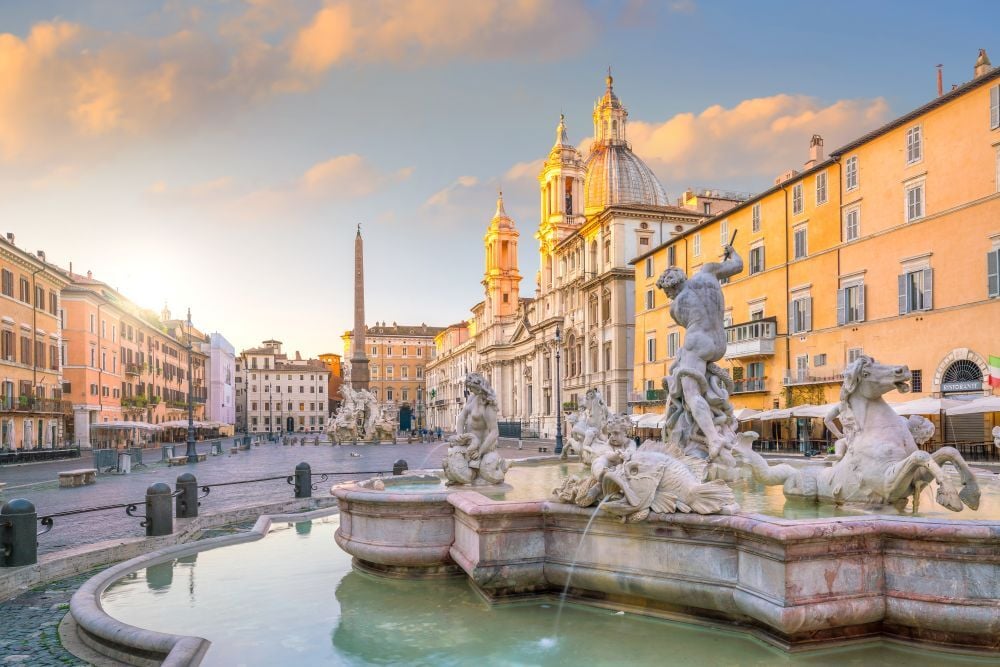
As Italian Renaissance architecture evolved into High Renaissance and formal Classicism in the 16th century, its concepts were perfected into ideal forms. At a similar time, the movement, drama and exciting theatre of Baroque Italy were also coming into view. From around 1600 to 1750, its associated architecture was dialling up the emotional experience of buildings, using light as a design tool with striking interiors that employed curves in sweeping forms. Sculpture and design were fused together in civic spaces that were tasked with making people feel moved in both the literal and metaphorical sense.
St Peter’s Square in the Vatican City was completed in 1667, and the Baroque ideology is present in every brick and every space there. The colonnades that embrace the square lead people into a space of monumental scale with the sculpted saints looking down on them from above. This is architecture in a living, moving and choreographed way that is dependent on the crowds within it that allow it to make real sense.
Towards the Future
As modernity traversed the globe in the early 20th century, it was met with more craft in the realms of Italian architecture. Traditional ideas of proportion and expression were augmented by the new structures of steel and mass-produced materials. Although ornamentation was to be reduced and minimised, new identities could be formed through rationality and purpose.
The requirements of a rapidly growing population mean that constraint and discipline have become a priority in urban planning and modern structures for Italian architecture. With such unparalleled beauty and history in the landscape to learn from, one can be certain its solutions will begin a new chapter in balance, form and expression for the country’s buildings.