

Published: 21 April 2026
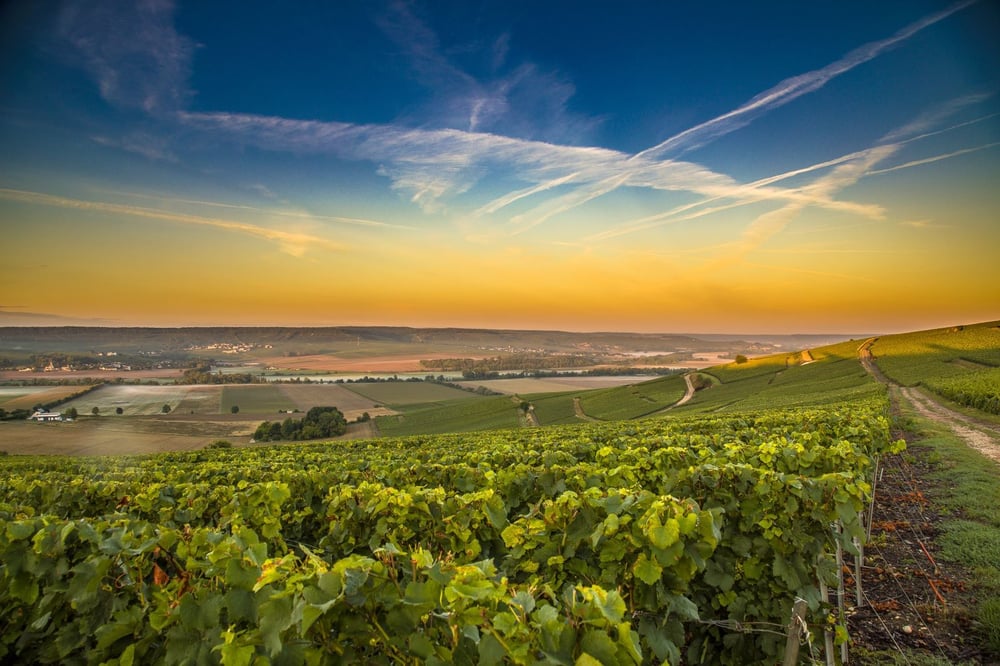
Just under an hour from the grand boulevards of Paris lies one of, if not the most famous, wine-producing regions in the world. Stretching across rolling hills and winding rivers, the Champagne region is defined by thousands of hectares of vineyards planted on chalk-rich soils that give the eponymous sparkling wine its unique character and, of course, taste. A historically cooler climate, mineral-rich soils and centuries of innovation have made the area the stand-out destination for sparkling wine on the planet.
Exploring the Champagne region offers more than simple wine tastings. This is an area dripping in history, heritage, and a few natural wonders besides the grapes that grow on well-tended vineyards. From the grand houses of Reims and Épernay to the quiet villages nestled in the rolling hills of the countryside, this Champagne may be a name known far and wide, but much of this region remains criminally underexplored.
From Rome to Reims
Like most of Western Europe’s early developmental history, much of what Champagne has today is owed to the Romans. In the Roman era, Reims was known as Durocortorum and served as the prosperous capital of the province of Gallia Belgica, eventually becoming one of the largest cities in the Roman Empire. Its ancient legacy is still visible today through grand structures like the Porte de Mars, the largest surviving Roman triumphal arch, and the Cryptoporticus, a preserved underground gallery that once supported the city’s forum. Perhaps its most lasting contribution to the modern region is the network of "crayères," or chalk quarries, which were originally excavated by the Romans for building materials and are now used as the iconic ageing cellars for the city’s many champagne houses.
It was the Romans who first introduced winemaking to this region when the fertile slopes along the Marne and Aube rivers were planted with vines to supply nearby settlements, and Reims itself was home to the Prefect’s personal cellar carved into the great chalk caves below the fledgling settlement’s surface. Whilst there have been many celebrated figures in Champagne’s history, few are as influential as a humble Benedictine Monk: Dom Pierre Pérignon, who worked as the cellarer at the Abbey of Hautvillers from 1668 to 1715. Although he did not invent sparkling wine as legend sometimes suggests, his work contributed to improving blending techniques and vineyard management, helping shape the early development of Champagne production.
During the eighteenth and nineteenth centuries, Champagne houses began to emerge as international brands. Producers developed the chalk caverns beneath the region extensively, particularly beneath towns such as Reims and Épernay, where tens of thousands of bottles could age in ideal conditions. Railways and improved transport links allowed Champagne to reach global markets, transforming the region into one of the most important wine-producing areas in France. Figures from this time period, like Madames Pommeray and Cliqueot, Jean-Rémy Moët and Lily Bollinger, all played a hand in the growth of the region's most valuable product and ensuring it survived through multiple wars, blights, and politics that could have crippled the region.
The First City of Champagne
Reims was once the coronation site for the kings of France at the great Gothic cathedral that dominates the centre of town. Filled with suitably regal ambience and architecture, it remains one of the most beautiful cities in France and a fitting chief settlement from which champagne production has evolved over the last few centuries. Several renowned producers are based in Reims, including the houses of Veuve Clicquot, Taittinger, Ruinart, Krug and Pommery. Visiting these estates to learn more of not just the story behind each brand, but the history of the city, is an invaluable learning curve and crucial to understanding how Reims has developed.
Many of these estates offer guided cellar tours that lead visitors through long underground tunnels carved into the chalk, where tens of thousands of bottles lie waiting to reach their potential in the darkness, in a network which goes on for miles beneath the city’s streets. Christmas is a particularly wonderful time to visit, with markets and illuminations bringing festive cheer to the frosty cobbles, and the Notre Dame Cathedral’s gothic facade is transformed by way of special light projections. Summers are long and hot, making it an ideal base to explore the rest of the region with numerous cycle paths and walking trails through the hills and valleys, and local trains to all the most prominent towns and villages.
Enchanting Épernay
Speaking of which, the most important settlement other than Reims is located about thirty kilometres south. Épernay is widely considered the heart and soul of the Champagne industry. The town sits along the banks of the Marne and is totally encircled by vineyards that climb the surrounding hillsides. Its most famous street, the Avenue de Champagne, is lined with the headquarters of major Champagne houses Moët & Chandon, Perrier-Jouët and Pol Roger. The avenue itself is a glamorous stretch of road, with the Champagne Museum proving a particular highlight thanks to its immersive exhibits and detailing of the region's history.
Away from the avenue, Épernay is also home to major brands such as Bollinger, Mercier, Gosset, and dozens of smaller vineyards and makers that are all reachable within a few minutes' drive, or via a scenic walk or cycle through the foothills on the region's vineyard trail. The crowning moment of the year for the town comes in December at Habits de Lumière, the town's light and bubble-filled celebration of its champagne heritage. The houses along the avenue all open their gates to allow the public to flood their yards, sipping bubbles, nibbling on hors d’oeuvres, and taking stock of the evening’s entertainment. Running from Friday to Sunday in the middle of the month, spectacular fireworks, glow-in-the-dark parades of dancers, light installations and even a silent disco, entertain thousands of visitors at one of the most family-friendly street festivals in the world.
Not all Crus are Created Equal
Hautvillers and Aÿ serve as the anchors of the Grande Vallée de la Marne, situated just north of the river that runs its course through neighbouring Germany. Unapologetically medieval Hautvillers, is defined by the Abbey of Saint-Pierre, noted as the focal point for the 17th-century refinements in blending and bottling wine that established the region’s technical standards. Today, the hillside village is best explored through its "enseignes", a collection of over 140 historic wrought-iron signs that line the narrow streets, signifying the trades of its previous occupants. Descending toward the river, the focus in Aÿ shifts to the high-intensity application of Grand Cru status. Strategically positioned as one of only 17 Grand Cru villages in the entirety of Champagne, just 5% of the region's 319 communes meet this classification.
The town’s south-facing slopes are the primary source for the structured Pinot Noir that anchors many of the most famous blends and cuvees of the most prestigious makers of champagne. This classification marks a distinct step up from the 42 Premier Cru villages and the vast majority of "Autre Cru" sites, representing the top of the historical Échelle des Crus price-fixing scale. Aÿ’a grand gatehouses of historic makers like Bollinger sit directly alongside active farmyards and ancient stone walls, for a charming, more rural aesthetic compared to the more cosmopolitan Reims and Épernay. Aÿ also serves as the historic seat for Deutz, known for its refined, elegant house style and formerly supplying much of Europe's 19th century royalty. Visitors can also explore the house of Ayala, which focuses on low-dosage, high-precision cuvées, and Gosset, the oldest wine house in the Champagne region pre-dating even the likes of Ruinart.
Exploring the Côte des Bar and Montagne de Reims
The Montagne de Reims is a high forested plateau between Reims and Épernay that serves as a stronghold for the Pinot Noir grape. Here, cool, chalky slopes provide the signature backbone and longevity for some of the region's most celebrated brands. In contrast, the Côte des Bar in the far south sits on a mix of limestone and marl, soils more closely related to the production of Chablis and Burgundy wines, resulting in a riper, more aromatic expression of the fruit. The reputation of these areas is built on a high concentration of Grand Cru villages and an increasingly influential grower movement. The Montagne de Reims is home to legendary villages such as Verzenay, Verzy, and Bouzy, where the fruit is highly sought after by major houses for its power and depth.
Meanwhile, the Côte des Bar has established itself as a pioneering frontier for viticulture, known for a high density of independent vignerons who champion organic and biodynamic practices. This area is particularly noted for its focus on single-vineyard bottlings, offering a contrast to the multi-village blends common in the north and providing a more intimate, craft-oriented perspective on the appellation. At the south-most limits of the champagne region lies the medieval city of Troyes, whose cork-shaped historic centre and timber-framed architecture serve as the logistical hub for the region's summer celebration of sparkling wine, Route du Champagne en Fête. This rotating annual tour of 20 producers seeks to highlight the achievements of lesser-known villages and establish more of a reputation for the southmost parts of the region, which like its northern neighbours, still produces exceptional sparkling wines.