

Published: 22 April 2026
The end of the second World War ushered in entirely new ways of approaching the reconstruction required from such a devastating conflict. There was a drive towards honesty, purpose and a comprehensive understanding that the functions of buildings and infrastructure would be much more complex than ever before.
Brutalist architecture was a key part of this shared trajectory of an emerging modernism that would soon shape a huge part of our planet.
What is Brutalist Architecture?
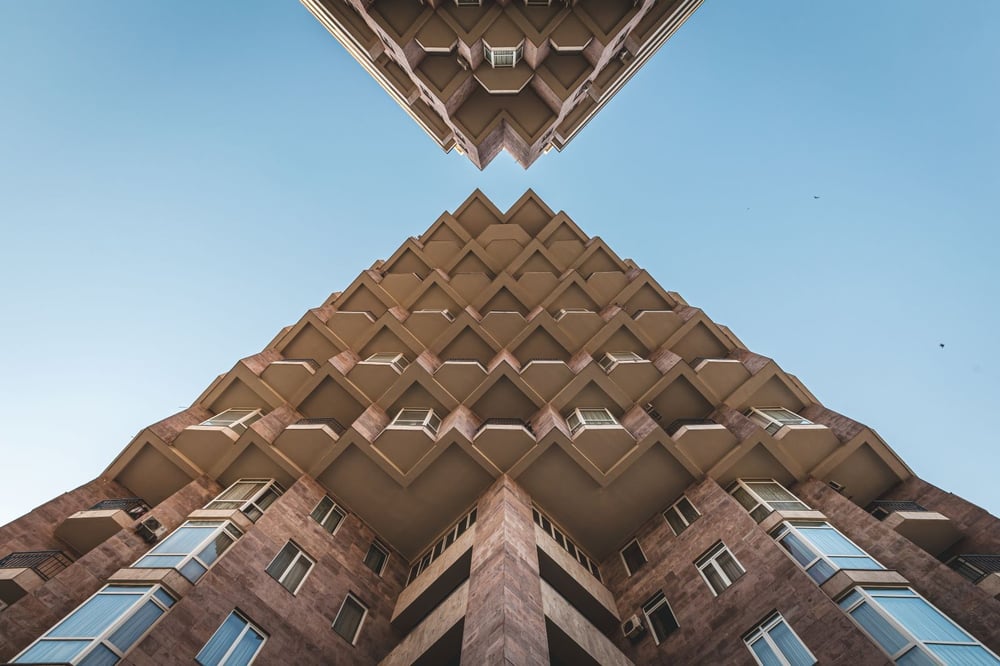
Brutalism is an architectural movement that took hold of Europe in the 1950s and quickly asserted its influence over the world. In essence, it is an art form driven by social purpose in a direct, raw and uncompromising manner.
The term itself comes from one of the most influential figures in architecture to have ever lived, Le Corbusier. He referred to the phrase béton brut, literally translated as raw concrete, to describe the stark unfinished concrete surfaces of the Unité d’Habitation housing project he designed in Marseille in 1952. This was the conceptual beginnings of Brutalism as a whole where the building appeared honest and unfiltered as an expression of functionality in everything one can see.
What are the Characteristics of Brutalism in a Building?
Defining Brutalism requires an understanding of how the visual elements of a building speak to its function and aims. Essentially, there is an important duality for each factor that can be observed in how it looks and what it does.
Raw & Unfinished Materials
The exposed concrete and materials display structural frameworks in a clear way.
Structural Honesty
Beams, columns and slabs are highlighted rather than concealed.
Monumental Massing
Large volumes display an overwhelming sense of permanence and anchoring weight in the landscape.
Geometric Forms
Bold & angular compositions are often repeated across the spaces
Lack of Ornamentation
Decoration is reduced or entirely absent. The shadows created by the building’s form and the texture of its materials become the aesthetic.
Recessed Windows
Deep set apertures create drama for light and shade upon facades.
Civic Ambition
Brutalism was widely used for buildings that served its people in a valuable and ethically beneficial way.
Britain & Brutalism
Although the movement has roots in France through the peerless work of Le Corbusier it required larger proofs of concept to become a true architectural language. This was provided by a post-war Britain during the 1950s as a response to:
- The wartime destruction of its cities
- An expansion of the Welfare State for its people
- A rise in programmes of public housing
- The growth of universities and post compulsory educational institutions
The term New Brutalism had been developed by the English architects Alison and Peter Smithson during this time and was eventually formalised by the eminent critic Reyner Banham in his 1955 essay The New Brutalism.
Alison & Peter Smithson
Alison and Peter managed to build on what Le Corbusier had uncovered to frame Brutalism as a philosophical and ethical position. They had both begun practising together after their marriage in 1949 and were part of a new generation that was unhappy with how early modernism had begun to soften and be shaped by traditional and familiar traits.
It was their aim to remove the polish and decoration that was creeping back in to replace it with a stricter and more disciplined design language where form followed function. This theoretical work was the driving force that established a Brutalist blueprint that the world could follow.
The Brutalist Buildings
Social purpose and community value were the foundations of every true Brutalist building. It became simple to see where Brutalism design should be applied in both materials and methods to speak to a population that had witnessed such changes and developments. Brutalist shapes and elements came to define buildings that would signal new ways forward for civic progress in the 1950s, 60s and 70s.
It was evident everywhere in the new built environment through:
- Government buildings
- Administrative centres
- Schools & universities
- Public housing estates
- Ambitious residential projects in urban areas
- Cultural institutions
With Britain acting as the successful proving ground it was not long until all of Europe followed suit. Brutalism then travelled to every corner of the globe with its instructional clarity on how a prosperous and radical new societal infrastructure can be established quickly in every city.
Brutalism in Action
There is no better way to observe how important and transformative Brutalism was than through the buildings that survive. They speak to the evolution of the design language and document how important it is for understanding architectural forms in the 21st century.
The Barbican Estate
London
1965-1976
The mixed-use nature of Grade II-listed Barbican Estate is a testament to the Brutalist ambition of its creators Chamberlin, Powell & Bon. In the heart of the City of London it is both a residential and cultural complex that combines towers, terraces, elevated walkways, schools and gardens into one cohesive urban footprint.
Its textured and tactile surfaces were constructed through board-formed concrete in a masterpiece of post-war city planning for the capital. Importantly, this was all created on a bomb-damaged site that literally saw The Barbican rise from the rubble in the city. This remains a striking social placemaking project that connected people in a new living environment with clarity, commitment and strength.
Boston City Hall
Boston
1968
There was certainly plenty of discussion and consternation when Kallmann, McKinell & Knowles completed their international competition-winning Brutalist building at the end of the 1960s.
The façade of exposed raw concrete and large cantilevers are a classic example of a building articulating its structure on the exterior. Large public and ceremonial spaces at the foot of the City Hall act as the foundation for a repeated grid pattern of stacked blocks with dramatic, heavy presence. It feels serious and immovable, lending a visual authority to the administrative and civic functions of the work that is carried out within its walls. There is an undeniable honesty about the structure that intentionally mirrors its democratic, governing purpose for the city and the people it serves.
Brutalism is an architecture of purpose. It serves as the perfect response to a world that suffered decades of upheaval and war with a need to rebuild and reassess at incredibly high speeds.
The construction, materials and supporting theories of Brutalism allowed the people to see new societies being shaped in permanence and function. This meant that they too could respond with pragmatism and commitment within a built environment that offered space to work, learn and ultimately grow.