Published: 4 November 2026
Buckinghamshire is one of the few English counties that still runs a fully selective state system. Thirteen grammar schools sit alongside a network of upper and all-ability schools, and the county is also home to some of the country's most famous independent schools. The result is outstanding choice, but also a complicated admissions landscape. This guide covers the top-performing schools for 2026 and explains how to secure a place.
How The Buckinghamshire System Works
To win a grammar school place, children sit the Secondary Transfer Test (STT) at the start of Year 6. Set by GL Assessment, it covers verbal reasoning, non-verbal reasoning and maths. A score of 121 or above makes a child "qualified" for all 13 grammar schools, and schools do not rank children by score, so 135 gives no advantage over 121. Around 9,500 children sit the test each year for roughly 1,900 grammar places.
For September 2027 entry, the test took place on 10 September 2026 and results were released on 9 October 2026. Secondary applications must be submitted by 31 October 2026. Families whose child narrowly missed 121 can request a Selection Review, which must be submitted by 30 October. Historically, most successful reviews have involved scores between 110 and 120.
Children who do not sit the test or do not qualify go to upper or all-ability schools, several of which perform well above national averages.
The Top Grammar Schools
1. Dr Challoner's Grammar School, Amersham
The boys' grammar in Amersham is consistently one of the strongest state schools in England. In 2024, around 85% of its GCSE grades were 9–7, and it regularly appears in national top-30 state school rankings. Founded in the 17th century, it combines academic rigour with a broad enrichment programme.
2. Dr Challoner's High School, Little Chalfont
Its sister girls' school is among the highest-ranked state schools in the county. It offers a strong academic offer at GCSE and A-level and a reputation for music, sport and student leadership.
3. Beaconsfield High School and Wycombe High School
These two girls' grammars are perennial high performers. Beaconsfield High ranks among the top three secondary schools in the county on recent data, and Wycombe High, one of the largest grammars in Bucks, has a strong record in STEM and sends many students to leading universities.
4. The Royal Grammar School, High Wycombe
The RGS is one of the oldest and best-known boys' grammars in the country. It is known for its sport, including rugby, alongside excellent academic results and a large sixth form.
5. Aylesbury High School and Aylesbury Grammar School
In the north of the county, Aylesbury High (girls) and Aylesbury Grammar (boys) both have excellent results. Aylesbury High admits around 189 pupils into Year 7 and was rated Outstanding by Ofsted in December 2023.
6. Co-educational Grammars
Families wanting a mixed grammar have several strong options: Sir William Borlase's in Marlow, Chesham Grammar School, Sir Henry Floyd in Aylesbury, Burnham Grammar School in the south of the county and The Royal Latin School in Buckingham, which is the top-performing school in the Buckingham area. Burnham admits around 180 pupils and gives priority to a defined catchment, so address matters there more than at some other grammars.
Leading independent schools
1. Wycombe Abbey
Wycombe Abbey in High Wycombe tops the county on GCSE results and is one of the world's leading girls' boarding schools. In 2025, 97% of its GCSE grades were 9–7 and 76% of A-levels were A* or A, with around 18% of leavers going on to Oxford or Cambridge. Founded in 1896, it takes girls from 11 and is predominantly a full boarding school. Boarding fees are roughly £20,500 per term once VAT is included.
2. Stowe School
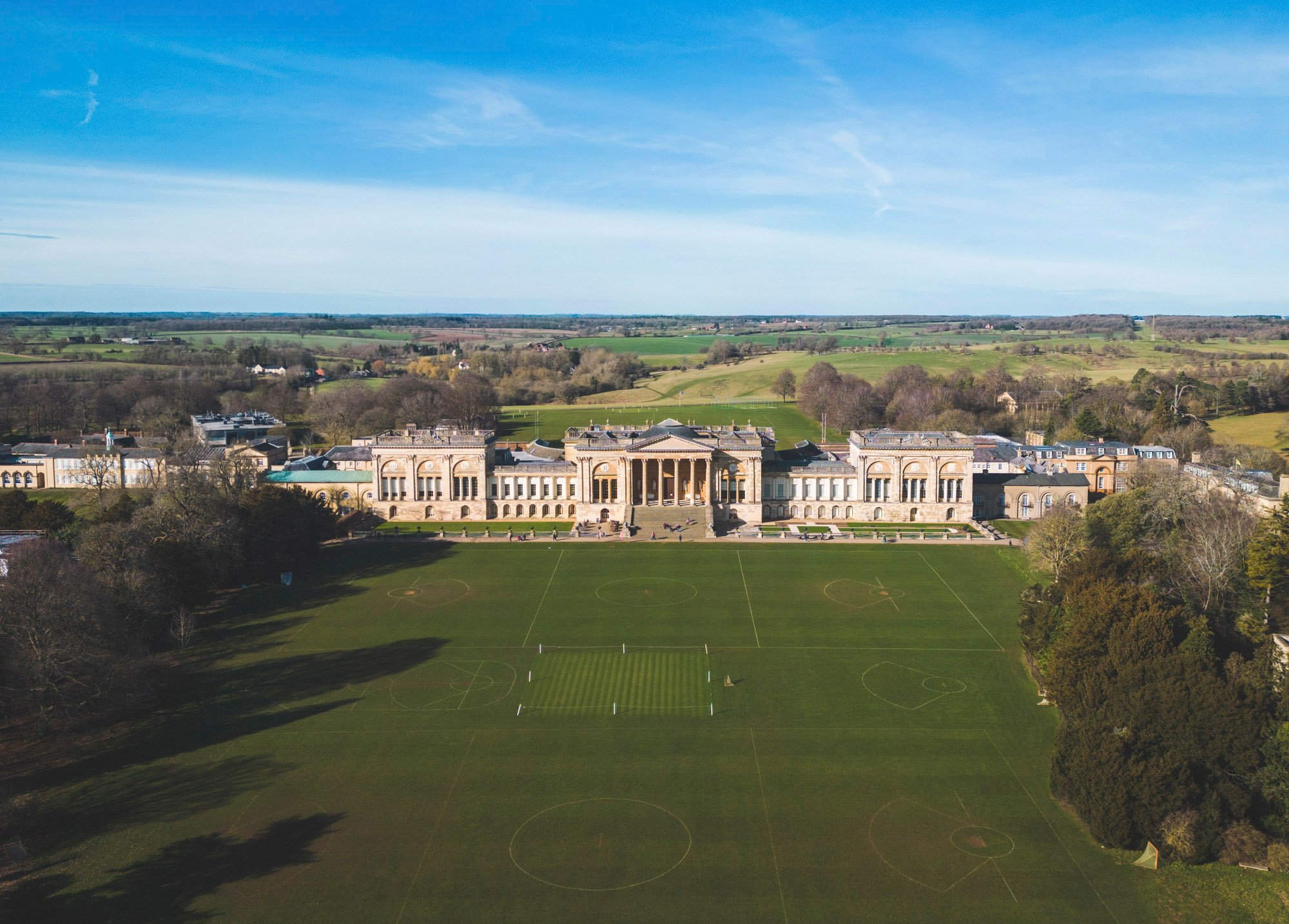
Set in famous landscape gardens near Buckingham, Stowe is a co-educational boarding school known for its breadth: arts, sport and outdoor pursuits sit alongside academics. It suits all-rounders who want space to develop interests beyond the classroom.
3. Other Independent Options
Pipers Corner near High Wycombe and Thornton College near Milton Keynes are well-regarded girls' schools with smaller classes and strong pastoral care. St Mary's School in Gerrards Cross and Akeley Wood Senior School near Buckingham also offer good alternatives for families seeking a non-selective or less pressured environment.
Strong Non-Selective Schools
Not qualifying for grammar school is not the end of the road. Buckinghamshire's upper and all-ability schools include some excellent performers. Waddesdon Church of England School, for example, ranks among the top 20 secondary schools in the county overall, ahead of many schools elsewhere in England. When visiting upper schools, look at Progress 8 scores, which measure how much pupils improve between primary and GCSE, rather than raw grades alone.
How To Choose
The county as a whole performs well: around 66% of GCSE grades in Buckinghamshire are 9–7 on one recent measure, compared with 56% nationally. With so many strong schools, the right choice depends on your child. Consider:
- Single-sex or co-ed. The county has an unusually wide spread of both.
- Admission rules. Each grammar sets its own oversubscription criteria; some use catchment areas, others distance.
- Journey time. A long commute can outweigh a small difference in results.
- Sixth form. Look at A-level results, subject range and university destinations.
- Fit. A highly pressured environment does not suit every able child.
Buckinghamshire offers some of the best state and independent education in the country. Dr Challoner's, Beaconsfield High and the Aylesbury grammars lead the state sector, Wycombe Abbey sets the pace among independents, and strong upper schools such as Waddesdon offer excellent routes for children outside the grammar system. If your child sat the test this autumn, make sure your application is in by 31 October.
Results and fees are based on the latest published data at the time of writing. Always confirm current figures and admission policies directly with each school.