

Published: 13 April 2026
Across hill towns and riverside centres and well-connected villages along the county’s northern edge, these five places stand out as some of Worcestershire’s best places to live.
History
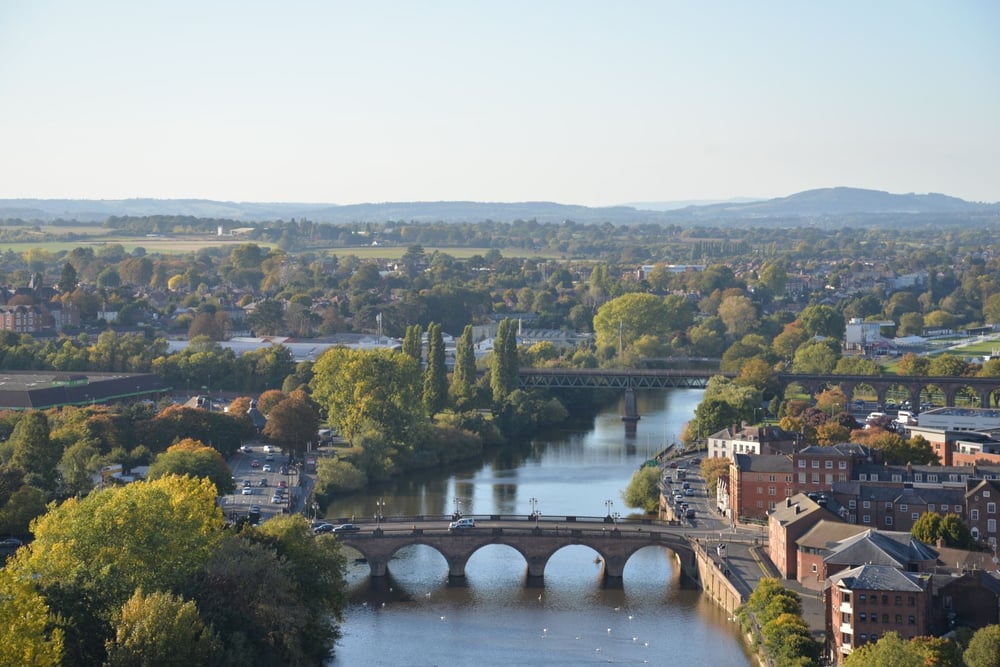
Shaped by the River Severn valley, the Malvern Hills and centuries of agricultural use, Worcestershire developed with relatively little heavy industry compared with neighbouring parts of the West Midlands. Roman salt production at Droitwich established early prosperity, while medieval monastic centres at Evesham and Pershore influenced settlement patterns that remain legible today. Market towns expanded gradually rather than through large-scale intervention, leaving a county defined by clear centres, established housing stock and close ties to the surrounding countryside.
For modern buyers, Worcestershire offers a balance of rural living and connectivity. Direct rail routes link the county to Birmingham and London, schooling spans both state and independent sectors, and many towns continue to function independently day to day rather than just as commuter towns.
Great Malvern
Set at the foot of the Malvern Hills, a nine-mile ridge of ancient granite more than 650 million years old, Great Malvern is a town where landscape is perhaps its best asset. The hills, surrounding commons and farmland are designated as an Area of Outstanding Natural Beauty and a European Geopark, with access routes beginning close to the town centre.
Great Malvern developed around its priory, founded in 1085 as a daughter house to Westminster Abbey, before expanding rapidly during the Victorian water cure era. While much of the town is Victorian in character, its history runs far deeper, with Iron and Bronze Age forts and trackways along the hills and early settlement clustered around the priory. The arrival of hydropathy in the mid-19th century – introduced by Doctors Gully and Wilson with the construction of the first water cure house in 1845 – transformed Malvern into a nationally recognised spa town. This prompted the construction of villas, terraces and civic buildings, many of which remain in use today.
Alongside this, Malvern Theatres entered the Guinness Book of Records in 2002 as the world’s smallest theatre, seating up to 12 people, whilst the continued presence of the Morgan Motor Company provides a rare example of small-scale manufacturing embedded within a market town. Strong local schools, rail connections to Worcester, Birmingham and London Paddington and a varied housing stock – ranging from Victorian and Edwardian homes on the slopes to newer family developments beyond the centre – reinforce its long-term appeal.
Hagley
Hagley sits on Worcestershire’s northern edge, close to the West Midlands, retaining a clearly defined village identity shaped by the estate of Hagley Hall, the Palladian seat of the Lyttelton family. Hagley Park extends across 350 acres of countryside at the foot of the Clent Hills.
Today, the village functions primarily as a residential centre, supported by local shops, pubs and services, with rail and road links placing Birmingham, Stourbridge and Kidderminster within practical commuting distance. Education is a notable strength, with Hagley Primary School, Haybridge High School and Hagley Catholic High School all well regarded, alongside access to independent institutions nearby. Housing ranges from period cottages and interwar houses to larger detached family homes on the village edge, with demand driven by schooling, transport access and village scale rather than short-term market cycles.
Bewdley
Bewdley is one of Worcestershire’s most architecturally coherent towns, set on the west bank of the River Severn and acting as a gateway to Wyre Forest, the UK’s largest native woodland. A former inland port, it prospered through river trade before the arrival of the railways. Much of its historic fabric has remained intact, including a clearly defined Georgian centre and a high concentration of listed buildings. It is also the birthplace of former Prime Minister Stanley Baldwin.
The river continues to shape daily life through parks, walking routes and boating, while the Severn Valley Railway provides both transport connections and tourism interest. Primary schooling includes St Anne’s CofE VC Primary School and Upper Arley CofE Primary School, with secondary options available in nearby Kidderminster. Housing is dominated by period properties close to the centre, with family homes extending outward and demand remaining competitive.
Tenbury Wells
Tenbury Wells sits in the far north west of Worcestershire, close to the Shropshire and Herefordshire borders and feels markedly more self-contained than the county’s southern towns. Edged by the River Teme, the town developed as a market centre for the surrounding Teme Valley, with agriculture and orchard farming shaping its economy long before any association with spa tourism. The 16th-century Tenbury Bridge, with its distinctive bend, still marks the approach to the town and acts as a clear threshold into its centre.
The addition of ‘Wells’ in the mid-19th century followed the discovery of mineral springs, leading to the construction of the Pump Rooms in 1862. While this period added a layer of civic architecture, Tenbury never fully reinvented itself as a spa town. Its character has remained rooted in local trade and farming reflected today in independent shops, small food businesses and events such as the annual Agricultural and Countryside Show.
Ludlow, Worcester and Hereford provide wider retail and cultural amenities, but the town itself operates with a degree of autonomy that attracts residents seeking scale and stability over convenience. Housing includes Georgian and Victorian terraces close to the centre, alongside larger detached homes on the outskirts, often offering more space and value than comparable market towns elsewhere in the county.
Pershore
Pershore is a compact market town set within the Vale of Evesham, long shaped by agriculture and food production. The town developed around Pershore Abbey, founded in 689 AD, which still defines both the skyline and the layout of the centre. Much of the surviving architecture dates from the medieval and Georgian periods, with a high concentration of listed buildings along the High Street and surrounding streets. The abbey’s 13th-century tower remains a key attraction, offering sweeping views across the Vale and towards Bredon Hill.
The River Avon runs parallel to the High Street and meadows, bridges and riverside paths connect directly back into the town, with Avon Meadow and surrounding wetlands providing open space within walking distance of the centre. This proximity to countryside, combined with a flat landscape, makes Pershore particularly well suited to walking and cycling .
Independent shops, an undercover market, pubs and restaurants support everyday needs, while food-led events reflect its orchard and market-gardening heritage, most notably the annual Pershore Plum Festival. Housing ranges from Georgian and Victorian homes close to the centre to larger family properties on the edges of town, contributing to steady demand driven by livability rather than short-term growth.
Worcestershire’s strongest towns have evolved slowly, shaped by landscape, agriculture and local trade. For those looking beyond headline hotspots, the county’s appeal lies in settlements that work well and consistently, balancing countryside, community and connectivity without ever feeling overdeveloped.