

Published: 23 March 2026
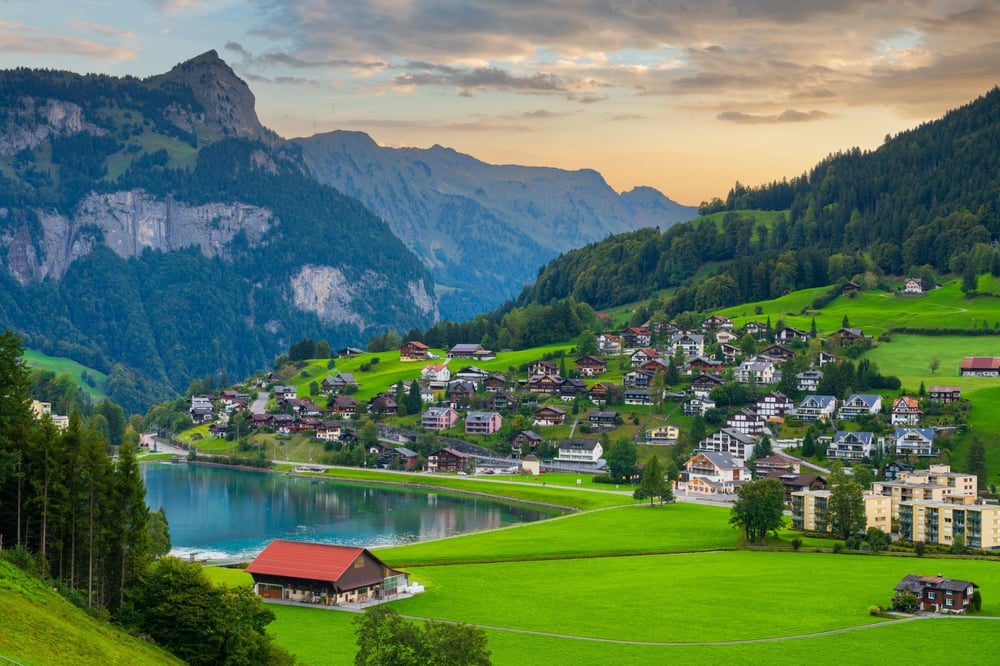
Beyond its many mountain peaks and deep glacial lakes, Switzerland is rightly lauded for the high quality of life offered to its residents. Its cities combine a distinct blend of modernity and natural beauty, whilst smaller towns and villages are often found in the most sublime places, nestled within deep valleys or along the shores of stunning bodies of water.
The best places to live in Switzerland offer a choice blend of world-class amenities, breathtaking scenery, and the sort of interconnectivity and options that many settlements in the world can only dream of. The following locations are the pick of the bunch across the thoroughly diverse map, which is Switzerland in terms of regional culture, that help define these locations as idyllic places to call home.
Zurich
Zurich began as a mountainous Roman customs post before developing into a medieval trading centre. By the 19th century, it had industrialised, and in the 20th century, it emerged as one of Europe’s leading financial hubs. Today, it anchors Switzerland’s largest metropolitan region. Whilst the Old Town offers narrow medieval streets and riverfront cafés, Zürich West, once an industrial hub, now houses galleries, restaurants and converted warehouses. In summer, locals swim in designated river baths along the Limmat or at lakeside “Badis”, which form a core point of summertime culture in the city and provide a reprieve from the mountain heat.
During the summer, Uetliberg mountain provides accessible hiking with sweeping views over the city and the surrounding ranges. Zurich Airport connects directly to major continental and international cities, while the main railway station is a national rail hub with fast trains to Bern, Basel and Milan, also offering the famous “Glacier Express” service that takes a delightful crawl through the region's stunning mountain passes in deep winter snow. The S-Bahn and tram network make commuting within the canton efficient and largely car-free. Zurich easily ranks among the best places to live in Switzerland thanks to its effortless, charming quality of life.
Geneva
Lake Geneva boasts two of the best places to live in Switzerland, and the first is the eponymous city, which sits on its shores. Unremarkable throughout much of early history, its significance exploded in 58 BC when Julius Caesar arrived to destroy the city's bridge, successfully blocking the migrating Helvetii tribe and marking Geneva’s definitive entry into the Roman Empire. Under Roman rule, Genava flourished as a vital military and commercial crossroads between the Mediterranean and Northern Europe. With the arrival of Christianity in the 4th century, it became a bishopric, cementing its status as a regional power centre through the Middle Ages. This ecclesiastical foundation eventually paved the way for the city’s radical transformation during the Reformation, when John Calvin reimagined the city as the "Protestant Rome".
Today, it's a dynamic city with a mix of 19th-century charm along the waterfront as a popular destination for wealthy travellers, and a more sprawling urban crawl. Inner-city areas like Carouge, with its Sardinian-influenced grid layout, feel distinct from the more formal lakeside districts. Residents gather along the quays in summer, swim near Bains des Pâquis, or head into the nearby Jura for hiking, whilst winter brings connections for skiing in many of the nearby mountain resorts. Geneva Airport sits minutes from the centre and offers strong European and intercontinental routes. High-speed trains reach Paris in just over three hours, while regional lines link to French commuter towns such as Chambéry and Evian.
Lucerne
Lucerne grew in importance along the medieval Gotthard trade route, linking northern Europe with Italy. Rail development in the 19th century strengthened its role as a transport crossroads, and now, direct trains connect Lucerne to Zurich in around 45 minutes and to Interlaken and Bern beyond, making it ideal for commuters or remote workers keen to embrace the charm of its famously beautiful lake and picturesque pre-alpine slopes surrounding it. The Old Town remains one of the city’s most charming attractions, with the Chapel Bridge and Water Tower anchoring the centre.
It’s a far smaller local community than the likes of Zurich and Geneva, but life here moves at a different pace. Hiking, skiing, and boating on the lake dominate living throughout the year, making it a popular place to start a home for young families. Boat services cross Lake Lucerne year-round, and Mount Pilatus and Mount Rigi are accessible by cog railway or cable car to really enjoy the benefits of this beautiful part of Switzerland.
Lausanne
The second addition to our list from the shores of Lake Geneva, Lausanne boasts the type of laid-back charm and old-world character that Geneva offers in small smatterings, whilst Lausanne brings spades full of it. The city’s neighbourhoods vary the further back one travels from the lakeshore up into the hills. The historic centre’s arcades and bistros are dominated by the shadow of the cathedral, while the area of Flon offers more artistic pursuits and nightlife, which appeal to the students from the nearby university. The outskirts to the east give way to rugged slopes and vineyards, such as those at Lavaux, and offer enhanced views of the surrounding shore and mountains.
The lakeside offers rowing, swimming and cycle paths, whilst ferry services connect the town to Evian across the water in France and Montreux with its beautiful castle, Château de Chillon, that perches magically on the water. The city lies on the main rail line between Geneva and Bern, with frequent services to Zurich, and is closely connected to Geneva airport. Nearby resorts in Torgon and across the water in the Portes du Soleil ski area boast their winter appeal, but the true appeal to Lausanne is the quieter pace of life on the lake, in contrast to Geneva.
St. Gallen
Founded around a 7th-century monastery, St. Gallen became a major centre of learning and later a textile powerhouse in Europe. The Abbey Library remains a symbol of its intellectual heritage. Housing over 170,000 rare volumes, it's considered one of the world’s most beautiful rooms, nestled within the compact city centre, dotted with painted oriel windows that mark the site of former merchant houses that brought St.Gallen so much of its wealth and grandeur. It’s a smaller-scale city whose appeal lies in its historical charm, and it is something of a crossroads between Switzerland and its German-speaking neighbours.
Lake Constance is less than an hour away and with it, the border crossing into Germany, whilst the Austrian border is also reachable from here within the same time frame by road or rail. Zurich is also reachable in roughly an hour, and the nearby Alpstein mountains provide hiking in summer and skiing in winter, for a continuation of the classic Swiss pastimes. One highlight for hiking is the Aescher Mountain Inn. Perched dramatically at 1,454 metres, the world-famous wooden guesthouse is built directly into the limestone cliffs of the Ebenalp. Accessible via a short, 20-minute downhill hike from the Ebenalp cable car station through prehistoric caves and a cliffside chapel, the inn is renowned for its rustic charm and traditional Appenzeller cuisine, such as hearty cheese tarts and local maize dishes.
Locarno
Locarno reflects Switzerland’s southern regions perfectly. Shaped by the Italian language and culture, the town sits on Lake Maggiore and enjoys one of Switzerland’s mildest climates. The Piazza Grande forms the social heart, hosting markets and festivals. Its distinct identity sets it apart from other entries on this list and cements its contention as one of the best places to live in Switzerland, for those who are fans of the Italian language, food, and traditions that shape this town.
The surrounding area is beautifully varied in a way which eclipses much of the rest of Switzerland. Cable cars climb to Cardada for panoramic views, while the nearby Verzasca Valley offers clear rivers and hiking trails. With improved rail links, especially the Gotthard Base Tunnel, now possible to connect to Zurich in under two hours and frequent connections into Italy, it’s a viable slice of paradise for those who commute in the less industry-heavy region.