

Published: 18 December 2025
Located between London and the hills of the South East, Berkshire is one of the country’s oldest counties. Its name derives from the Saxon Berrocscir, meaning “the wooded shire,” a nod to the forests that once covered much of the region. Those woodlands, together with the Thames Valley, gave rise to centuries of agriculture and trade.
Today, Berkshire has evolved into one of the UK’s most successful counties, home to global companies along the M4 corridor and thriving creative industries around Reading and Maidenhead. The Great Western Railway in the 19th century brought waves of growth and connection, linking its towns to London in under an hour. Windsor Castle and Eton College remain symbols of the county, but Berkshire’s strength lies just as much in the everyday quality of its smaller communities.
Many residents come for work and stay for quality of life with strong performing schools, safe neighbourhoods, and genuine community involvement. This guide showcases five villages and market towns, each a clear example of Berkshire’s finest qualities, different in character, but together shaping its continued appeal.
Cookham
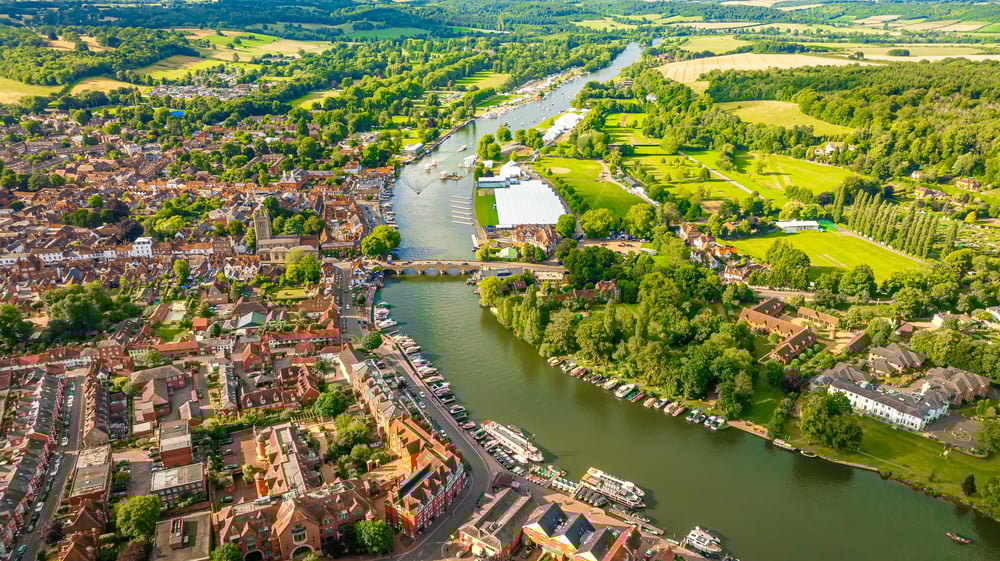
Cookham lies on the north bank of the Thames in the Royal Borough of Windsor and Maidenhead, retaining its historic core within a formally recognised conservation area. Cookham’s charm is centuries deep. Its iron bridge, built in 1867, connects the village to the rest of Berkshire and once served as a vital crossing for traders and travellers. Over centuries, Cookham evolved as a rural riverside community and later became a retreat for artists and writers drawn to its landscape. The painter Stanley Spencer, who lived and worked here, made the village part of British cultural history, and Cookham’s artistic links remain central to its identity. The Stanley Spencer Gallery showcases the painter’s work, and local art societies maintain an active presence.
Wander through Cookham’s centre and one will find independent cafés, Sunday lunch staples such as The Bel & The Dragon, and locals who actually stop to chat. Community is big in Cookham, with groups often organising fairs, river events, and heritage walks, and the village’s riverside festivals and conservation activities reinforce that cultural continuity. For walkers, the nearby Thames Path offers scenic walking routes, and for those wanting to visit the city, there is easy access to London via Maidenhead station and the M4 corridor. The population mixes between professionals, retirees, and creatives who share a respect for the area’s heritage and riverside setting.
Pangbourne
Set on one of the prettiest stretches of the Thames, Pangbourne is a village in West Berkshire with roots stretching back over a thousand years. Once part of Reading Abbey’s lands, it later became known for its Victorian riverside properties and boathouses. Author Kenneth Grahame lived here, drawing inspiration from the river for his ‘The Wind in the Willows’, and The Swan Inn and the historic toll bridge are landmarks tied to classic English literature and travel writing. The setting on the Thames provides continual inspiration for art, photography, and local storytelling, linking modern residents with the area’s creative past.
Pangbourne’s riverside layout and surrounding hills preserve the charm of a traditional English village. There’s a small but satisfying high street with a butcher, deli, boutique shops, and a handful of cafés, and the Thames Path runs through the village, making evening walks something of a ritual. Pangbourne College adds to the area’s reputation, whilst community events from the annual fête to charity swims keep residents connected. Although commuting distance to Reading and London makes Pangbourne an accessible area to live, many locals are happy enough with dinner by the river, with boats passing by.
Caversham
Historically part of Oxfordshire until 1977, Caversham has long served as a semi-rural counterpart to Reading, just across the River Thames. The village has medieval significance, with traces of Caversham Castle dating back to the 13th century, and the former Caversham Court estate, now public gardens, offering one of the finest river views in Berkshire. Victorian and Edwardian architecture give much of the area its texture, with large properties with bay windows and generous gardens.
The high streets of Church Street and Gosbrook Road buzz with independents, including coffee shops, a thriving bookshop and a farmers’ market twice a month. Weekends spill out onto the river at Thames-side parks, like Christchurch Meadows and Caversham Court Gardens, and every summer the area bursts into life with festivals and food fairs. Caversham also has micro-neighbourhoods with their own identities. Caversham Heights is the greener, hilltop stretch with stunning views, Central Caversham feels lively and walkable, and Lower Caversham along the river is home to some of the area’s most desirable properties. The housing stock attracts families and professionals who want character homes, green space, and good schools whilst retaining access to Reading’s theatres, arts venues, and cultural calendar. The result is a lively, well-connected community that still feels like a village on the edge of the city. Families love the schools and parks, professionals appreciate the easy access to London, and long-time residents take pride in how the area has evolved without losing its community core.
Twyford
Twyford, meaning “double ford,” originated as a rural crossing point and expanded with the arrival of the Great Western Railway in the 19th century, when it was transformed from a farming area into a well-connected village. The station brought new residents, new industries, and the beginnings of Twyford’s commuter identity. Unlike many places that grew too fast, though, Twyford never lost its scale or focus.
Community is the heart of Twyford and the high street is the village’s social hub. There is a traditional butcher, an independent coffee shop or two, a deli, a couple of well-kept pubs, and cricket, tennis and bowls clubs. Events such as Twyfest and the Beer Festival are fixtures on the social calendar, and village performances and charity events form the backbone of local engagement. Parks and family-friendly spaces keep weekends full, whilst the nearby Loddon Valley adds a green backdrop for walks and cycling. The rail station makes it ideal for commuters to Reading, Maidenhead, or London, with the Elizabeth Line now stopping at nearby stations and tightening connections. Twyford offers the balance of convenience and community. It is close to major employers and rail links, yet friendly, functional and full of heart.
Wokingham
Wokingham is an ancient market town, once a centre for cloth making, which has since grown into a thriving place surrounded by farmland and royal forest. More recently, careful regeneration has modernised the town centre, adding pedestrian-friendly squares, new cafés, public art, and housing, whilst preserving historic buildings and the tradition of the weekly market. Wokingham is also one of Berkshire’s greenest towns. Dinton Pastures Country Park, a 450-acre oasis of lakes and trails, sits just a few minutes away. Inside the town itself, Holt Copse and Joel Park offer woodland walks, whilst smaller parks and playgrounds are dotted throughout residential areas.
For a relatively compact town, Wokingham punches above its weight culturally. The local institution, Wokingham Theatre, stages an impressive calendar of performances throughout the year, and the Wokingham Music Club brings in live acts across genres. During summer, the Wokingham Festival turns the town into an open-air celebration of music, food, and art. Beyond the big events, the town invests in public sculptures, pop-up exhibitions, and the nearby Museum of Berkshire Aviation adds another cultural layer for history enthusiasts. Wokingham regularly features near the top of national quality-of-life rankings. Families are drawn in by top-performing schools, clean streets, and a sense of safety that feels old-fashioned in the best possible way.
Few counties manage to balance history, accessibility, and quality of life as effectively as Berkshire. The area has evolved across centuries without losing the traits that made it desirable in the first place. Market towns have modernised, but their centres remain walkable and independent. Villages have grown, but still revolve around schools, sports clubs, and local shops. Berkshire is not just a place to visit or commute through, but somewhere to put down roots, build connections, and live well for the long term.