

Published: 14 April 2026
England is not a country that shouts about its golf. There is no single defining landscape, no obvious centre of gravity. Instead, the quality lies in contrast. Along the coastline, links courses sit exposed to wind and tide, shaped as much by weather as by design. Inland, heathland courses run through pine and heather, their fairways folding naturally into sandy soil. Elsewhere, parkland courses stretch across old estates, where trees, water and long-established ground create a different kind of course.
What unites them is restraint. Many of the best courses were laid out in the early years of the 20th century, when architects worked with what was already there. There is very little sense of imposition. Fairways follow the natural contours of the land, bunkers feel camouflaged rather than decorative, and greens sit where they make sense. Nothing is overworked.
There is also a consistency to the clubs themselves. These are places that have held their identity. The clubhouses are functional without being austere, the atmosphere is measured, and the focus remains on the quality of the course. It is a model that has not needed much adjustment.
Across England, the result is a depth of quality that is easy to underestimate. These are the courses that define it.
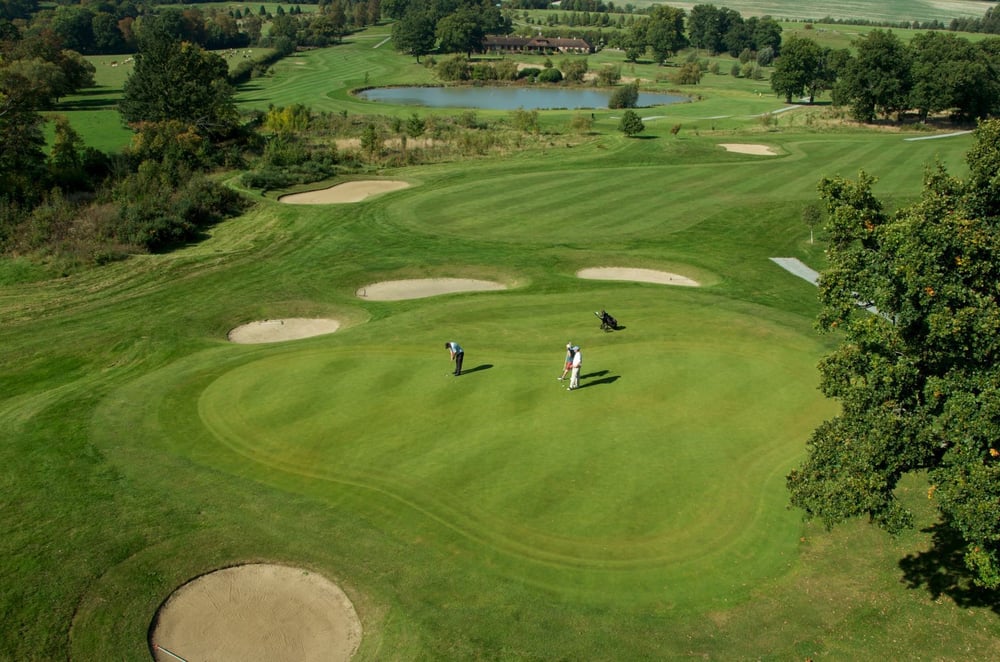
Sunningdale Golf Club, Berkshire
Sunningdale is often the starting point for any conversation about inland golf in England. It sets a standard that few others quite match. The Old Course, laid out in 1901, is built on placement. Miss your position and the hole quickly tightens.
There is a clarity to the design that becomes more apparent as the round progresses. Fairways move through heather, greens are set naturally into the land, and nothing feels forced. It is a course that rewards control and thought, rather than power.
The New Course, which runs alongside it, has a slightly different character. There is more movement in the terrain, a greater sense of exposure, and a marginally sterner test overall. It complements the Old rather than competing with it.
Royal St George’s Golf Club
On the Kent coast, Royal St George’s feels entirely different. This is links golf at its most unpredictable. The ground rises and falls without warning, fairways twist and break, and the wind is hardly ever still. It has hosted The Open Championship multiple times, and the course carries that authority.
There is very little room for complacency here. Lies are uneven, distances are difficult to judge, and recovery shots often require imagination rather than precision. It is not a course that can be mastered in a single round. Each visit feels slightly different, shaped by conditions as much as by the layout itself.
Swinley Forest Golf Club
Swinley Forest is almost the opposite in tone. Private, understated and rarely discussed in broad terms, it is nonetheless consistently ranked among the best courses in England. There is nothing dramatic about it at first glance. The routing is compact, the holes sit close together, and the scale feels modest.
But the detail is where it excels. Greens are subtle and complex, positioning is critical, and the overall experience builds gradually. It is a course that rewards familiarity. The more it is played, the more it reveals.
Royal Birkdale Golf Club
Further north, Royal Birkdale represents a more structured version of links golf. The dunes frame each hole clearly, creating a sense of order that is not always present on coastal courses. Fairways are defined, sightlines are strong, and the routing is easy to follow.
That clarity does not make it easy. Bunkering is precise and often punishing, and the wind remains a constant factor. It is a course that rewards discipline and consistency, rather than improvisation.
Woodhall Spa Golf Club (Hotchkin Course)
Inland again, the Hotchkin Course at Woodhall Spa offers one of the most distinctive challenges in England. The terrain is sandy and firm, with fairways bordered by heather and bunkers that are both deep and strategically placed.
There is a directness to the design. Each hole presents a clear objective, but achieving it is another matter. Greens are fast and often subtly contoured, requiring careful approach play. It is a course that rewards precision from start to finish.
St George’s Hill Golf Club
Set within a private estate, St George’s Hill brings elevation into play in a way that few courses in the south of England can match. The ground rises and falls across the site, creating long views and a sense of space that feels removed from its surroundings.
The Red and Blue courses are particularly strong, combining generous fairways with demanding approach shots. The scale of the landscape gives the course its character, but the design remains controlled and measured.
Walton Heath Golf Club
Walton Heath offers a different interpretation of heathland golf. The Old Course is expansive, with wide fairways bordered by heather and an extensive network of bunkers that dictate strategy.
It has hosted major championships, and that heritage is evident in its structure. Each hole is clearly defined, and mistakes tend to come from poor positioning rather than unpredictability. On exposed days, the wind adds an additional layer of difficulty.
Saunton Golf Club (East Course)
On the north Devon coast, Saunton’s East Course feels more remote. The dunes are larger, the landscape more expansive, and the sense of isolation stronger. It is a course that sits comfortably within its environment.
The routing is fluid, moving naturally through the terrain, and the greens are understated but effective. Wind is always a factor, shaping both strategy and execution. It is a course that rewards patience and control.
The Addington Golf Club
Closer to London, The Addington stands apart for its landscape. Set on higher ground, it combines woodland with open, exposed holes, creating a varied and occasionally dramatic round.
Recent restoration work has clarified the design, reintroducing width and definition. The result is a course that feels both distinctive and coherent, with a stronger sense of identity than many others nearby.
Royal North Devon Golf Club
Royal North Devon offers something entirely different again. Often described as the oldest course in England, it sits on common land, where sheep and horses still move freely across the terrain.
The layout has changed very little over time. There is a rawness to it, a sense that the game is being played on the land rather than imposed upon it. It is not defined by perfection, but by authenticity.
What becomes clear, when moving between these courses, is the range. England does not rely on a single type of golf. Instead, it offers a series of distinct experiences, each shaped by its landscape and history.
Links courses test adaptability, with wind and ground conditions dictating play. Heathland courses rely on precision and positioning, their sandy soil creating firm, fast surfaces. Parkland courses introduce a different set of considerations, where trees and water shape the round.
There is also a shared philosophy. The best courses do not try to overwhelm. They do not rely on spectacle or excess. Instead, they allow the land to define the game.
It is this balance, between variety and consistency, that makes England such a compelling golfing country. It may not always present itself as the obvious choice, but once explored, it becomes difficult to overlook.