

Published: 26 March 2026
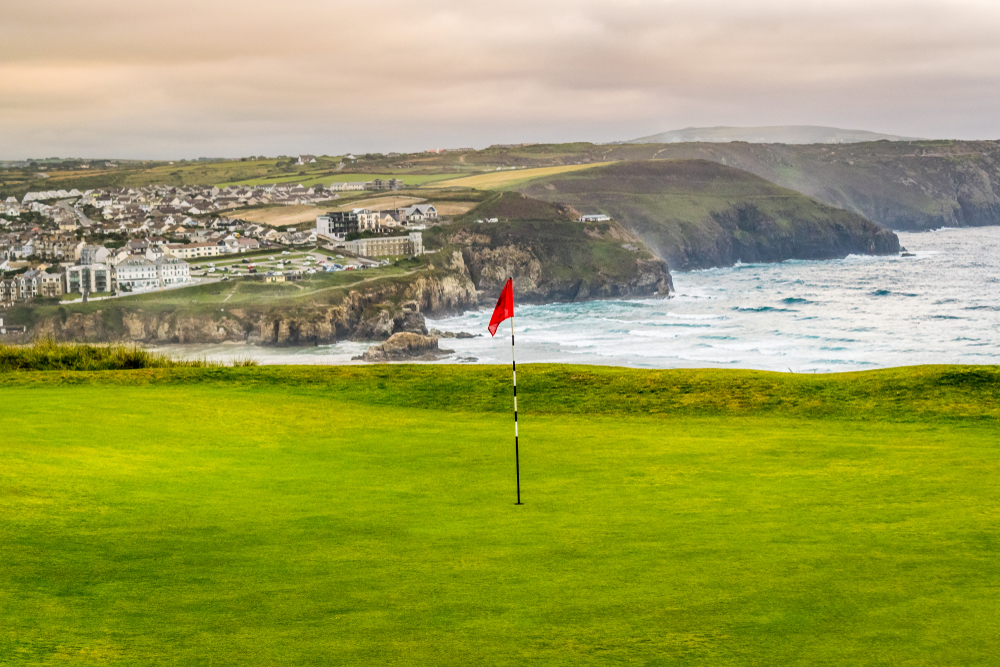
Cornwall is best known for its dramatic coastline, sandy beaches and characterful coastal towns, but it is also home to some of England’s most highly regarded golf courses. Attracting more than five million visitors each year, the county hosts more than 30 golf courses, with a notably high proportion located on or near the coast, giving the county one of the strongest concentrations of seaside golf in England.
Set on the westernmost edge of the South West Peninsula and forming a large part of the Cornwall National Landscape, the county’s distinctive coastal geography plays a defining role in its golf. Steep Atlantic-facing cliffs, wide sandy bays and wind-sculpted dunes shape traditional seaside links, while sheltered estuaries and rias along the south coast, including those of the Rivers Fal and Fowey. The county also benefits from a mild maritime climate, with relatively low winter frost incidence and free-draining sandy soils that allow many courses to remain playable year-round.
Below we profile five of the best golf clubs in Cornwall for 2026 and offer an overview of where the county’s most established golf is found today.
St Enodoc Golf Club, Rock
Set beside the Camel Estuary and overlooking Padstow, St Enodoc’s Church Course is one of Cornwall’s most celebrated historic sporting landscapes. First established in the late 1800s and later developed by James Braid, it is currently ranked 74th in the world by Top 100 Golf Courses, placing it among an elite international group.
The course takes its name from the small 13th-century church located beside the 10th green and has hosted numerous national amateur championships, whilst remaining widely regarded as one of the most demanding links tests in southern England.
At just over 6,500 yards, the course is not long by modern standards, but it is physically demanding due to steep sand dunes, uneven ground and constant coastal exposure to wind. The layout rises and falls naturally through tall grasses and open terrain, requiring careful positional placement rather than power.
Trevose Golf & Country Club, Padstow
Located a short distance along the coast from St Enodoc, Trevose Golf & Country Club offers a larger-scale championship seaside course. Designed by leading architect H.S. Colt and opened in 1925, the Championship Course has a long history of hosting major amateur and professional events, including the Brabazon Trophy and European Legends Links Championship.
The course is laid out in two halves. The first nine holes run close to the sea, where prevailing Atlantic wind and exposed ground play a major role, while the second half moves slightly inland, changing direction and feel. Fairways are generally wide, making the course accessible, but strategically placed bunkers and rough penalise inaccurate shots.
Unlike many inland courses, Trevose remains playable throughout the year due to its free-draining sandy soil and firm ground. Calm conditions allow for lower scores, but strong winds quickly increase the difficulty, making tactical course management essential.
St Mellion Estate, Plymouth
Close to the Devon border, St Mellion Estate is one of the South West’s most established championship golf venues. Its flagship Nicklaus Course opened in 1988 and was the first European course personally designed by Jack Nicklaus. Since then, it has hosted numerous high-profile professional tournaments, including European Tour events and national championships.
The estate comprises 36 holes across two courses, making it one of the largest purpose-built golf resorts in the region. The Nicklaus Course is a par-72 measuring 6,284 yards. It is characterised by carefully positioned strategic bunkers, water features and a particularly demanding mid-round stretch of holes. While suitable for a range of players, success depends on accurate shot placement and disciplined decision-making rather than distance alone.
The estate’s second course, the Kernow, originally opened in 1976 and was redesigned in 2008. Shorter and more forgiving than other Cornish courses, it provides a more relaxed secondary alternative while retaining professional-level design standards.
Bude & North Cornwall Golf Club, Bude
Golf has been played at Bude since 1891, making it one of England’s oldest surviving seaside courses. Originally known as North Cornwall Golf Club, it emerged during the Victorian era as Bude developed into a popular coastal resort town. Early design work is widely attributed to Tom Dunn, a prolific course designer of the period whose course routing remains close to its original late-19th-century layout.
However, the club’s history reflects broader social change. Initially exclusive, it expanded after the First World War to include local working players, eventually merging into a single members’ club in 1949. Today, the par-72 course remains largely unchanged in character. Built on natural coastal ground, it features uneven fairways, firm turf and fast-running surfaces.
Perranporth Golf Club, Perranporth
Perranporth Golf Club is one of Cornwall’s most exposed and natural courses. Designed by James Braid in the early 20th century, it has changed very little since opening and remains a clear expression of his minimal-intervention design philosophy and is regularly cited among Cornwall’s strongest links layouts.
The course plays to a par-72 and measures just over 6,700 yards, but its difficulty lies in relentless coastal exposure rather than length. Firm fairways allow the ball to travel along the ground and subtly shaped greens reward precise approach shots. Positioned along high clifftop and deep sand dunes, it is heavily influenced by Atlantic winds and several holes involve blind tee shots, which require confidence and familiarity with the layout.
The same coastline that draws millions each year for beaches and walking routes also dictates how the game is played here. For those visiting Cornwall in 2026, the appeal is straightforward. The courses are distinctive, landscape-led, and the settings are uncompromised. The golf remains closely land-connected and for a county already defined by its coastline, the best golf feels like a natural extension of it.