

Published: 8 January 2026
Prague’s historic city centre is known for its Gothic towers, Baroque palaces and nineteenth-century boulevards that sit astride the banks of the Vltava River, and is one of Europe’s most beloved old capitals. Neighbourhood rhythms shift depending on which side of the river one finds themself, along with the setting of the sun, with some areas exploding into life at night yet remaining sleepy during the day and vice versa.
For travellers seeking refined accommodation, Prague offers an impressive range of high-end boutique hotels and restored historic residences. From former palaces and grand nineteenth-century buildings, whether waking to the bells of Old Town churches, walking quiet palace streets beneath Prague Castle or settling into one of the elegant residential quarters just beyond the medieval core, the following neighbourhoods represent some of the best areas to stay in Prague, offering a distinct perspective of the city.
Old Town (Staré Město)
The Old Town remains the area most closely associated with the city’s medieval identity, and for many, the best area to stay in Prague for convenience. Defined by its ornate Old Town Square, where the Astronomical Clock continues its hourly chorus beneath the Gothic towers of the Church of Our Lady before Týn. Narrow lanes branch away from the square toward the Vltava River and the Charles Bridge, creating a dense network of streets lined with Renaissance merchant houses, Baroque churches and centuries-old cellar bars beneath street level. Staying in Old Town places visitors within walking distance of many of Prague’s most recognisable landmarks and attractions while immersing them in the city’s historic atmosphere from the moment they step outside their hotel.
Among the most distinguished places to stay here is The Mozart Prague, a riverside palace hotel occupying a complex of historic buildings once home to aristocratic families and visiting artists. The property preserves the grand interior spaces and elegant courtyards while offering spacious suites overlooking the Vltava. Nearby, The Grand Mark Prague provides another exceptional option, set behind a quiet courtyard garden within a seventeenth-century palace. The hotel offers some of the largest suites in the city centre, along with one of Prague’s rare private gardens for an added dose of seclusion to retreat from the lively streets of the bustling old town.
Malá Strana (Lesser Town)
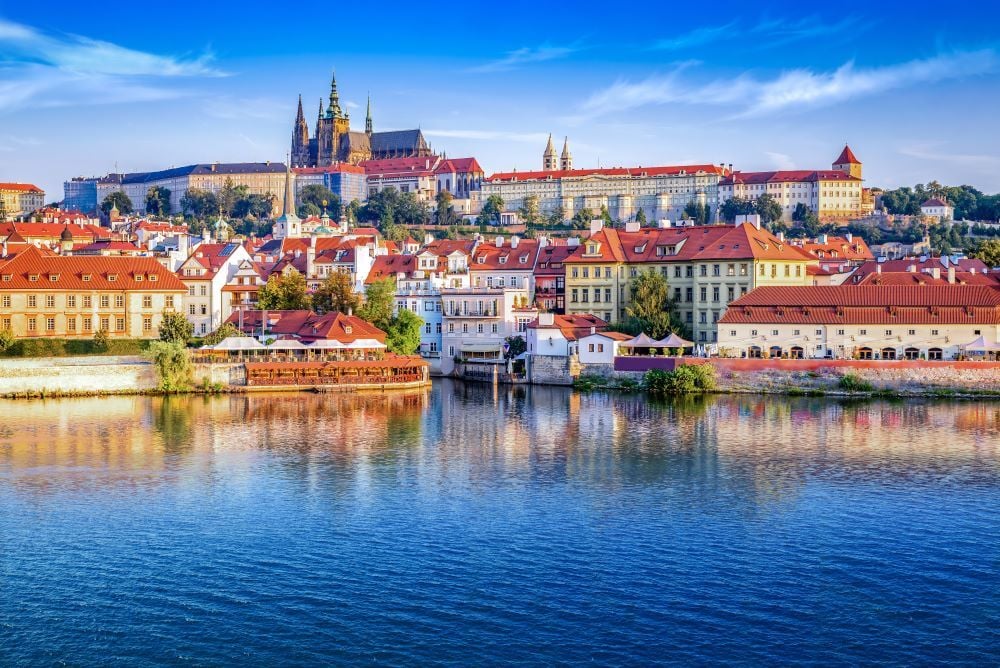
Across the river beneath Prague Castle lies Malá Strana, or as it is more commonly known, “the lesser town”. Despite its location serving as the other half of the Charles Bridge, Malá Strana feels calmer than Old Town, offering a more intimate and historic setting for a stay in Prague. Developed largely during the Baroque era after a series of devastating fires gutted the neighbourhood, the area is famous for its access to the palaces and embassies of the castle district above it, and the quiet residential squares away from the river. Streets climb gradually up toward the towering castle complex, passing churches, gardens, and small cafés tucked along the way.
The Alchymist Grand Hotel and Spa stands out as one of the city’s most characterful boutique properties. Occupying a restored Baroque palace, the hotel is richly decorated with frescoed ceilings, antique furnishings and dramatic staircases that reflect the building’s aristocratic past. Nearby, the Mandarin Oriental Prague offers another remarkable setting. Housed within a former Dominican monastery, where cloisters and vaulted corridors have been carefully integrated into the hotel’s design. Its spa, built within a restored Renaissance chapel, provides one of the most fantastic wellness spaces in the city, and is perfect for taking the edge off exploring the steep slopes of Malá Strana in their entirety.
New Town (Nové Město)
Despite its name, the New Town dates back to as far as the fourteenth century, when Holy Roman Emperor Charles IV ordered the planned expansion of medieval Prague. Today, its wide boulevards, theatres and bars are centred around the bustling axis of Wenceslas Square, named after the eponymous prince whose towering statue dominates the centre. The neighbourhood has long served as modern Prague’s commercial and cultural hub, making it an ideal base for visitors who want immediate access to most of the city’s best attractions, aided by the presence of metro stations and the iconic trams of the city.
One of the most impressive hotels in this part of the city is the NH Collection Prague Carlo IV. The property occupies a monumental nineteenth-century bank building, distinguished by its neoclassical façade and grand interior hall, supported by imperious marble columns. The building’s historic banking chamber has been transformed into a dramatic lobby space, while below ground, an extensive spa and pool complex occupies former vaults, with some well-preserved nods to its past. Another well-heeled option nearby is The Julius Prague, a modern residence-style hotel offering spacious suites that are ideal for longer stays, and minutes away from the bustle of the square and surrounding neighbourhoods.
Vinohrady
Just east of the historic centre lies one of Prague’s most elegant residential neighbourhoods. Vinohrady was developed during the late nineteenth century as the city expanded beyond its medieval walls. Characterised by broad avenues lined with Art Nouveau apartment buildings, tree-lined squares and a lively café culture, the name itself refers to the vineyards that once covered the surrounding hills, although today the area is known more for its restaurants, wine bars and parks than for viticulture. Staying in Vinohrady offers a more laid-back look at Prague, a perspective enforced by the winding streets and a strong neighbourhood identity.
Boutique hotels here often occupy historic residential buildings rather than large palace complexes. Le Palais Art Hotel Prague is one of the district’s most distinguished properties, set within a Belle Époque mansion that once catered to visiting artists and intellectuals. The hotel preserves decorative plasterwork, sweeping staircases and high ceilings, while offering views across the rooftops toward Prague Castle. This is a prime location to access Riegrovy Sady, a hillside park famous for its sweeping views across the city skyline, particularly at sunset.
Smíchov and the Riverside
South of Malá Strana along the western bank of the Vltava lies Smíchov, a district that has transformed dramatically over the past two decades. Once known primarily for its factories and breweries, the neighbourhood has evolved into a lively riverside quarter with modern cafés and restaurants along the waterfront promenades, retaining its post-industrial aesthetic and, in some areas, is delightfully grungy.
One of the area’s most notable hotels is the Aria Hotel Prague’s sister property, the Andaz, located in the historic Sugar Palace, a neoclassical building from 1916 situated on Senovážné Square. Though technically situated just beyond Smíchov itself, this five-star Hyatt property offers easy access to these riverside districts while providing a refined base to explore from. Featuring rooms and suites adorned with artwork inspired by Prague’s myths and legends, guests can enjoy unique dining at ZEM, an avant-garde bistro that merges Czech ingredients with Japanese flavours, or relax at the MEZ Bar, which serves cocktails inspired by Bohemian mythology.