

Published: 8 June 2026
Few privileges in the world of connoisseurship compare to gaining unfettered access to one of history's most consequential minds. This summer, Sotheby's New York will offer exactly that, when the Jay T. Snider Collection of Benjamin Franklin goes under the hammer on 24 June 2026.
Assembled over more than three decades by Philadelphia entrepreneur and philanthropist Jay T. Snider, the collection stands as the greatest private assembly of Franklin material ever to come to auction. Printed ephemera, books, letters, almanacks, manuscripts, newspapers, and artefacts together trace the full sweep of Franklin's life, from his earliest days as a printer to his final years as a statesman. Taken as a whole, they constitute an intimate, firsthand portrait of the polymath, rendered not through biography or retrospect, but through the primary documents he produced, annotated, and handled himself.
About Jay T. Snider and His Private Collection
Jay T. Snider is a Miami-based entrepreneur, executive, and philanthropist with a lifelong commitment to American history and its preservation. He is the founder and chairman of UNIT Solutions, a company specialising in the design and manufacture of non-lethal firearms for professional and civilian training, and previously served as president of both the Philadelphia Flyers NHL franchise and Spectacor.
For decades, Snider has built and sold several distinguished single-owner collections of historic Americana at major auction houses, each reflecting his scholarly instinct for material of genuine consequence.
As Snider has said of the collection, "I have collected rare Americana for 46 years, and my greatest joy was in studying the most remarkable American, Benjamin Franklin. I am so pleased that it is now in Sotheby's expert hands, where evermore valuable information will be added, for the benefit of the next owners and our understanding of American history."
Highlights From the Collection
1. The Founding and Funding of the Pennsylvania Hospital | Estimate: $150,000 – 200,000
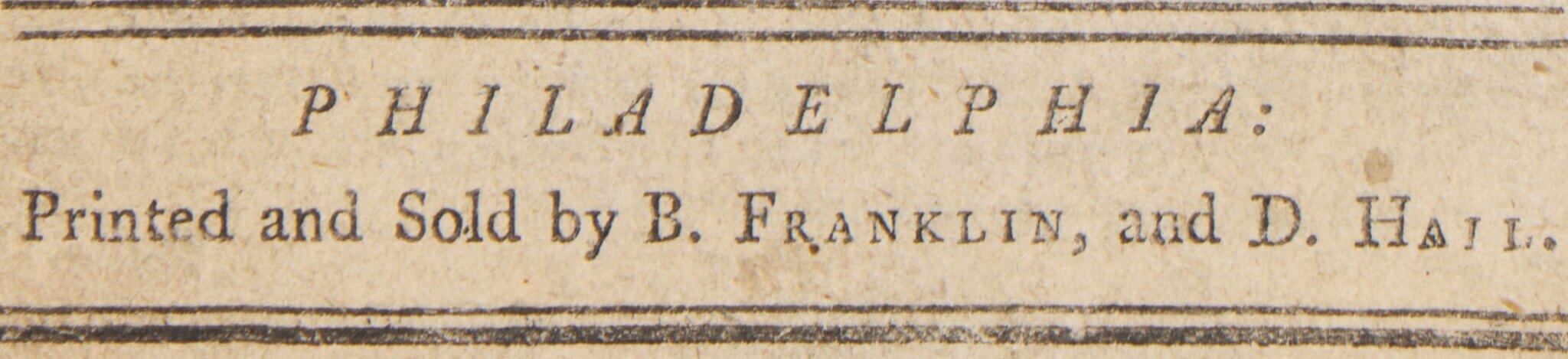
Among the most historically significant lots in the Snider collection is an archive of approximately 347 promissory notes related to the establishment of the Pennsylvania Hospital, printed by Franklin and his partner David Hall between 1751 and 1754. The first chartered hospital in the United States, it was founded by Franklin and leading American surgeon Thomas Bond "for the reception and cure of the sick poor...free of charge”. Franklin persuaded the provincial assembly to grant £2,000 toward the institution on the condition that an equal sum be raised through private subscription. The goal was met with room to spare, and Franklin himself pledged £25 to the cause.
The promissory notes amount to a who's who of mid-eighteenth-century Philadelphia. Among the earliest subscribers were Israel Pemberton, known as the King of the Quakers, alongside physicians, merchants, architects, and civic leaders whose names appear throughout the foundational chapters of American history. Several notes were witnessed by Timothy Matlack, who would go on, in the summer of 1776, to engross the Declaration of Independence on vellum for the signatures of the Continental Congress delegates.
The archive is preserved across two formats. The larger quarto notes, originally printed two to a page, have been disbound and housed individually in custom buckram binders alongside the well-worn covers of their original volumes. The smaller octavo notes remain bound in three volumes with marbled boards, one of which bears the red wax seal of witness Charles Caldwell.
Franklin himself, in his autobiography, reflected that few of his political ventures gave him greater satisfaction than the founding of the hospital. For the collector, this archive offers something rarer still: direct, documentary access to one of Franklin's proudest achievements, told entirely through the paper trail he left behind.
2. Benjamin Franklin’s Copy of John Dickinson’s ‘Letters From a Farmer in Pennsylvania’ | Estimate: $80,000 – 120,000
Published across twelve consecutive issues of a Philadelphia newspaper between late 1767 and early 1768, John Dickinson's 'Letters from a Farmer in Pennsylvania' was the first rigorous legal examination of the rights of British colonists in America. Within a year of its initial appearance, the work had been reprinted in at least eight editions across the colonies and abroad, a testament to its immediate and galvanising impact on colonial political thought.
Franklin was central to the work's international reach. He arranged for its publication in London and personally facilitated its translation into French by his close friend Jacques Barbeu-Dubourg, who had frequently translated Franklin's own writings. The French edition, printed with a false Amsterdam imprint, is the version offered here, and its provenance is extraordinary: the copy belonged to Franklin himself and is likely a personal gift from the translator, possibly even bound by him. It bears his shelfmark on the front endpaper, thought to be inscribed by his grandson Benjamin Franklin Bache.
After Franklin's death in 1790, the majority of his library was sold to Philadelphia bookseller Nicholas Dufief. Unable to find a buyer for a French-language work in the city, Dufief eventually presented the volume to Dickinson himself, acknowledging his authorship in a personal inscription that remains in the book today.
3. One of Franklin’s Very Earliest Surviving Letters | Estimate: $40,000 – 60,000
Long before Franklin was a statesman or a scientist, he was a bookseller. This single half-page autograph letter, signed and dated 12 June 1738, captures him in that earlier role, writing to John Ladd, a surveyor from Gloucester County, New Jersey, to confirm the dispatch of two volumes of Don Quixote and a copy of The Ladies' Library, while reserving a complete set of Pope's translation of Homer pending Ladd's reply.
The letter is brief and transactional in tone, yet its significance far exceeds its contents. Of the nine Franklin letters known to predate it, five survive only through published transcriptions, their originals lost, and two exist solely as drafts. This letter to Ladd is, therefore, the third earliest complete Franklin letter known to exist and the earliest currently held in private hands.
Ladd's purchases are corroborated by entries in Franklin's own shop book and ledger, grounding the letter within a documentary record of Franklin's commercial life that scholars have long relied upon. Ladd himself went on to serve as a justice of the peace, a member of the New Jersey Assembly, and a member of the Governor's Council, lending the correspondence a biographical resonance on both sides.
For the collector, the letter's appeal is straightforward: it is a rare, complete, and verified autograph document from the hand of one of history's most written-about figures, dating to a period from which almost nothing in his own hand is known to remain.
4. Perhaps the Only Letter to His Wife in Private Hands | Estimate: $35,000 – 50,000
Written in London on 20 February 1774, this single-page autograph letter from Franklin to his wife of over four decades, Deborah Read Franklin, is among the most personal items in the Snider collection. Brief and tender in tone, it was sent simply to satisfy her wish to receive a letter by every departing ship and closes with characteristic warmth: "I continue, Thanks to God, in good Health and Spirits... My love to our children. I am ever Your affectionate Husband."
The biographical circumstances surrounding the letter make this piece all the more poignant. Franklin had courted Deborah since their teenage years in Philadelphia, and though his diplomatic postings kept him in London for years at a stretch, their marriage was by all accounts happy. What Franklin could not have known when he wrote this letter was that Deborah would die of stroke in December 1774, before his planned return home the following May. The reunion he anticipated never took place.
The letter was written at a turbulent moment in Franklin's public life. Just two months prior, he had publicly acknowledged his role in transmitting the Hutchinson Letters to Boston, a politically explosive act for which he was stripped of his position as deputy postmaster-general of the colonies.
Its institutional rarity places it in a category of its own. Of the 132 letters Franklin wrote to Deborah, the vast majority are held by the American Philosophical Society, with the remainder distributed across other institutions. Not one is known to the editors of the Papers of Benjamin Franklin to reside in a private collection, making this letter, in all likelihood, unique in private hands.
The Auction
Selected pieces from the collection were on public view at the Library Company of Philadelphia from 5th to 7th May, before transferring to Sotheby's galleries at the Breuer Building from 17 to 24 June. Bidding opens on 3 June as part of Sotheby's Book Week series, with the live auction taking place on 24 June at 2pm EDT in New York.