November, 2026
Prime Property In Q3: What Sold And Why Buyers Bought
UK Sotheby’s International Realty sold £491 million worth of property between July and September 2026. A look ...
Explore more
Rent
Prime
Countryside
South West
Scotland
Latest stories
November, 2026
UK Sotheby’s International Realty sold £491 million worth of property between July and September 2026. A look ...
Explore moreNovember, 2026
The UK remains one of the most open property markets in the world. There is no residency requirement, no citiz...
Explore moreNovember, 2026
For many international and regional buyers, London is less a place to live full time than a place to return to...
Explore morePublished: 6 August 2024
French painter Claude Monet has gone down in history as one of the most famous artists ever. Born in Rue Laffitte, Paris in 1840, he is best known as one of the founders of the Impressionist style, a precursor to modernism. Many of his en plein air oil paintings, such as ‘Bridge over a Pond of Water Lilies’ and ‘Meules’ (Haystacks), are instantly recognisable to people worldwide.
In this piece, we take a closer look at Monet’s life and explore 10 interesting facts you might not know about him.
Monet’s works weren’t initially well received, at least not by the conservative Salon de Paris, which continually rejected them. Other artists, including Pierre-Auguste Renoir, Camille Pissarro, Paul Cézanne, Edgar Degas, and Edouard Manet, faced the same lack of recognition. Together they formed the Anonymous Society of Painters, Sculptors, and Engravers and decided to host their own exhibition, whichlater became known as the first Impressionist exhibition.
One of the paintings displayed at the 1874 exhibition was Monet’s ‘Impression, Sunrise’. Art critic Louis Leroy was not a fan of the piece, which shows a hazy scene at Le Havre port, disparagingly calling the work “impressionistic”. According to Sotheby’s article, Monet and his fellow artists embraced the term and a movement of like-minded artists now had a name that would cement their place in art history.
Monet grew up in the coastal town of Le Havre, Normandy. As a teenager he started drawing charcoal caricatures. These sold well and soon he attracted the attention of a more well-known artist.
Eugene Boudin was a French painter best known for his landscapes, which he painted while outdoors, also know as en plein air. He became aware of Monet when their work was displayed alongside each other. Boudin recognised Monet’s talent, and introduced him to painting outdoors, and taught him to study the changing weather and light. Painting outside was still considered rather unusual at the time, but Monet must have enjoyed it as soon he left caricatures behind. Monet later credited Boudin as the inspiration for his success.
In 1861, at the age of 20, art student Monet was called to serve in the army. While his father was wealthy enough to have bought his discharge, he elected not to as he hoped the military discipline would encourage his son to have a change of heart about trying to make a career as an artist. Monet was sent to serve in Algiers, Algeria and on induction promised to serve for seven years. However, after a year he contracted typhoid and was soon saved from the remainder of his service by his wealthy aunt. No works survive from this part of his life, but he later suggested “the impressions of light and colour that I received there… contained the germ of my future researches”.
In 1868, Monet attempted to kill himself by jumping off a bridge into the River Seine. This came at a time when he was struggling to support his family, shortly after the birth of his first son. While he survived, he was known to continue to suffer from depression at other stages in his life, particulalry following the death of his first wife Camille in 1879.
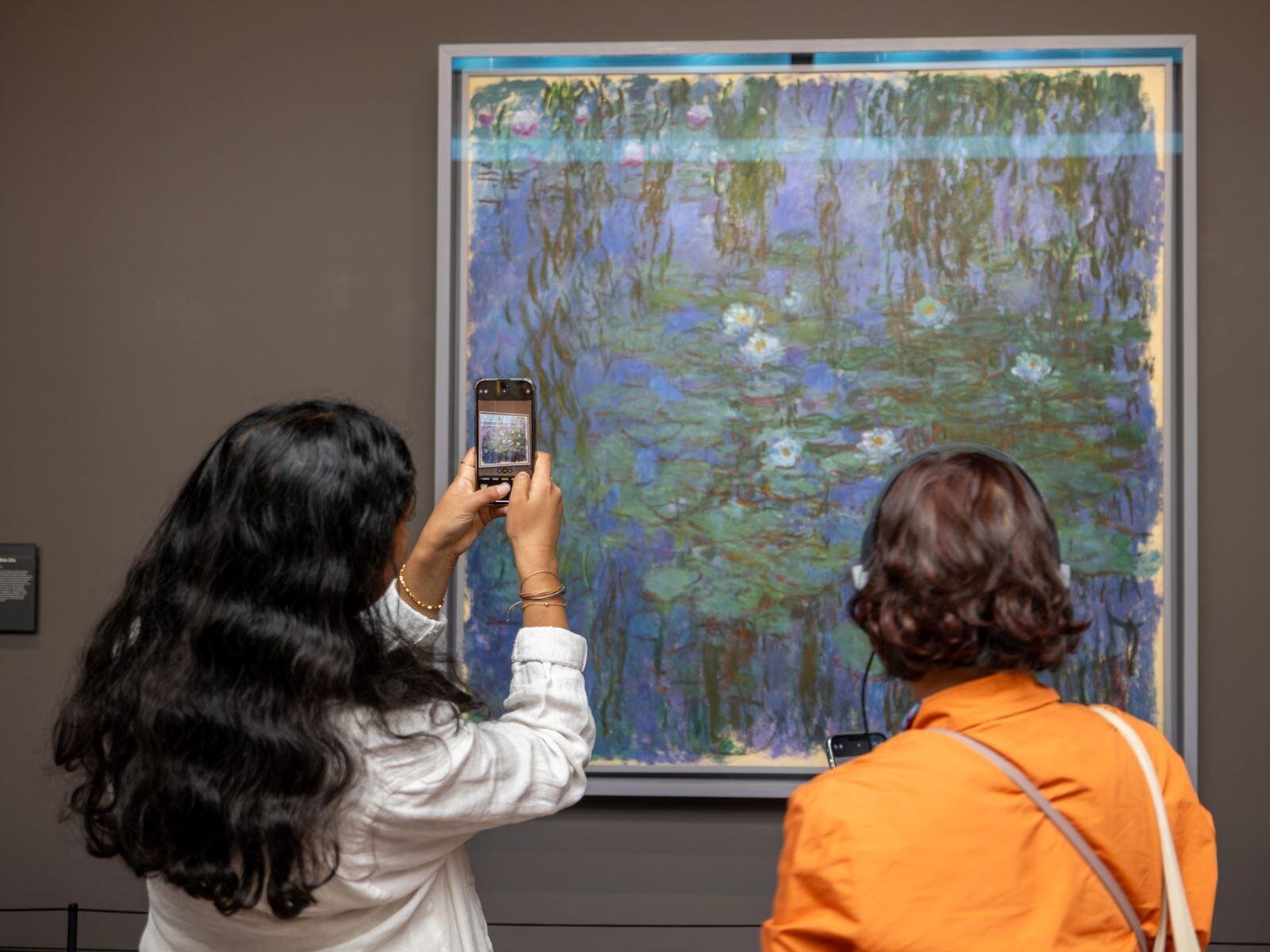
Monet was a fan of Japanese art and culture. While this interest was evident on a “superficial” level from his early work, such as ‘La Japonsaise’ (Camille Monet in Japanese Costume), it later became even more apparent. He created a Japanese-style garden, featuring a bridge and waterlily pond, and these were the major focus of his work in later life. Such was his fascination, he produced around 250 oil paintings of the waterlilies alone. While Monet never travelled to Japan, he began collecting Japanese prints in the 1860s and bought woodblocks from noted artists including Hokusai, Utamaro and Hiroshige. By the end of his life, he owned 231 pieces of Japanese art from 36 artists.
If painting was the primary passion of Monet’s life, gardening must take second place. His garden was carefully planned and later became the source of inspiration for much of his work. He planned around the changing seasons, planting a mix of vines, bulbs, perennials, and annuals, and arranged plants with height and colour in mind. In 1893, Monet bought the land in front of his home in the village of Giverny and created a Japanese-style water garden. The surface of the water was covered in imported water lilies, which the gardeners he employed to help with the upkeep were instructed to keep dust-free.
In 1905, Monet started to have problems with cataracts. It wasn’t until 1923 he underwent the surgery he needed. His work during this period features more reds, oranges, yellows, and purples, as well as larger brush strokes. This is thought to be as a result of his inability to distinguish cooler colours, and the fact the condition blurs the vision. After surgery, Monet destroyed much of the work from this part of his life. Post-surgery, his work featured more blues, and some believe this is because he could see ultraviolet wavelengths after the surgery.
Monet’s former home and its stunning gardens have been open to the public since 1980. Hundreds of thousands of people visit each year. It’s a joy to walk the gardens and see those impressive waterlilies, and the place he called home.. It also offers a fascinating insight into his life and there’s even an opportunity to see his large collection of Japanese art, as this is hung in rooms throughout the house.